







Recent Public Posts - [guest]
| Re: Railways Bill 2025: introducing and designing Great British Railways - general topic In "Looking forward - the next 2, 5, 10 and 20 years" [377148/31038/40] Posted by ChrisB at 21:06, 17th July 2026 |      |
From the Telegraph, via MSN
Safety warning over Labour’s rail nationalisation plans
Labour’s plans to nationalise the railways threaten to undermine passenger safety, the industry watchdog has warned.
The Office of Rail and Road (ORR) said the upheaval of bringing train operators and Network Rail under state control meant senior railway executives could lose focus and start to ignore safety issues.
Great British Railways (GBR), the new state-backed operator, is taking back rail line franchises as they come up for renewal, with remaining routes expected to come under government control by the end of next year.
However, Richard Hines, the chief inspector of railways, said in the ORR’s annual report on health and safety that the disruption of nationalisation could bring short-term risks.
“GBR is an opportunity to strengthen safety across the network but change must not weaken protections or blur who is responsible for keeping passengers and workers safe,” he said.
“As rail reform progresses, there must be clear leadership, clear accountability and a relentless focus on known safety issues, such as over-speeding.”
Richard Holden, the shadow transport secretary, said the warnings from Mr Hines were “concerning” and urged Labour to review its timetable for nationalisation.
He said the findings added to concerns about the impact of the GBR plan, which the Conservatives have claimed will drive up costs and leave passengers and taxpayers to pick up the bill.
“The chief inspector of railways has warned that Labour’s reforms risk weakening accountability for rail safety,” he told The Telegraph.
“Safety must always come first. If the evidence shows that Labour’s rushed nationalisation is compromising the safety of passengers and railway staff, it should be paused until ministers can guarantee those risks have been addressed.”
In its report, the ORR also warned that work to tackle deaths on level crossings, worker fatalities and over-speeding at junctions – recent cases of which had come close to “catastrophic outcomes” – should not take a back seat to the creation of GBR.
The regulator said the crash near Bedford last month – which killed a driver and sent 100 passengers to hospital after a stationary train was hit by another travelling at 50mph – had provided a “sobering reminder” of the severe consequences of rail accidents.
The ORR said that while progress had been made in some areas, “the management of risk is not yet delivering the overall level of control and assurance required”.
The regulator singled out over-speeding, in which trains travel faster than the permitted limit for a given section of track, as one of the most significant safety issues.
Mr Hines also said the safety of maintenance staff remains a key concern after a spate of deaths, including one in March when a track worker was killed after being hit by a train at 110mph.
Fatalities on level crossings are also increasing, he said, while the derailment of an express train following a landslide at Shap, Cumbria, indicated the increased importance of “robust infrastructure management in the face of environmental pressures”.
He said the causes of the Bedford collision remain under investigation.
Initial findings suggested the driver who was killed passed a red signal after the train in front came to an unexpected halt when a fault triggered its emergency braking system.
A Department for Transport spokesman said: “Safety on our railways is our number one priority.
“We have been working with industry and independent experts, including the ORR, to make sure safety is at the heart of everything we do as we set up Great British Railways.
“Our rail reform programme will not change the robust rules in place on safety and as we move forward, we will build on the decades of experience which have meant Britain’s railways consistently rank among the safest in the world.”
Labour’s plans to nationalise the railways threaten to undermine passenger safety, the industry watchdog has warned.
The Office of Rail and Road (ORR) said the upheaval of bringing train operators and Network Rail under state control meant senior railway executives could lose focus and start to ignore safety issues.
Great British Railways (GBR), the new state-backed operator, is taking back rail line franchises as they come up for renewal, with remaining routes expected to come under government control by the end of next year.
However, Richard Hines, the chief inspector of railways, said in the ORR’s annual report on health and safety that the disruption of nationalisation could bring short-term risks.
“GBR is an opportunity to strengthen safety across the network but change must not weaken protections or blur who is responsible for keeping passengers and workers safe,” he said.
“As rail reform progresses, there must be clear leadership, clear accountability and a relentless focus on known safety issues, such as over-speeding.”
Richard Holden, the shadow transport secretary, said the warnings from Mr Hines were “concerning” and urged Labour to review its timetable for nationalisation.
He said the findings added to concerns about the impact of the GBR plan, which the Conservatives have claimed will drive up costs and leave passengers and taxpayers to pick up the bill.
“The chief inspector of railways has warned that Labour’s reforms risk weakening accountability for rail safety,” he told The Telegraph.
“Safety must always come first. If the evidence shows that Labour’s rushed nationalisation is compromising the safety of passengers and railway staff, it should be paused until ministers can guarantee those risks have been addressed.”
In its report, the ORR also warned that work to tackle deaths on level crossings, worker fatalities and over-speeding at junctions – recent cases of which had come close to “catastrophic outcomes” – should not take a back seat to the creation of GBR.
The regulator said the crash near Bedford last month – which killed a driver and sent 100 passengers to hospital after a stationary train was hit by another travelling at 50mph – had provided a “sobering reminder” of the severe consequences of rail accidents.
The ORR said that while progress had been made in some areas, “the management of risk is not yet delivering the overall level of control and assurance required”.
The regulator singled out over-speeding, in which trains travel faster than the permitted limit for a given section of track, as one of the most significant safety issues.
Mr Hines also said the safety of maintenance staff remains a key concern after a spate of deaths, including one in March when a track worker was killed after being hit by a train at 110mph.
Fatalities on level crossings are also increasing, he said, while the derailment of an express train following a landslide at Shap, Cumbria, indicated the increased importance of “robust infrastructure management in the face of environmental pressures”.
He said the causes of the Bedford collision remain under investigation.
Initial findings suggested the driver who was killed passed a red signal after the train in front came to an unexpected halt when a fault triggered its emergency braking system.
A Department for Transport spokesman said: “Safety on our railways is our number one priority.
“We have been working with industry and independent experts, including the ORR, to make sure safety is at the heart of everything we do as we set up Great British Railways.
“Our rail reform programme will not change the robust rules in place on safety and as we move forward, we will build on the decades of experience which have meant Britain’s railways consistently rank among the safest in the world.”
| Re: Class 175s to Great Western Railway (GWR) In "Across the West" [377147/28982/26] Posted by ChrisB at 20:59, 17th July 2026 | |
Posted on X
The first @GWRHelp Class 175 has been repainted in GWR livery - this is set 175103, seen here being shunted by 08629 at Wolverton Works prior to delivery to GWR.
Click on the link to view the photo.....and its NOT in GBR colours either. Possibly the very last in GWR....
| Re: 2 car trains (again) In "Portsmouth to Cardiff" [377146/32239/20] Posted by John D at 20:39, 17th July 2026 | |
I guess everyone has to wait until Lord Hendy produces the LTRS (the 30 year long term rolling stock strategy).
Earlier in the year suggested it would be published by the summer. Parliament has just started summer recess, so wasn't issued before the summer recess. The following suggests it will later this year
The most upto date info is the Parliamentary answer by Lord Hendy 2 days ago relating to SWR diesel fleet, I can't find any update on GWR diesel fleet
15 July 2026
The Class 158 and Class 159 diesel trains used on services between London Waterloo and Exeter are expected to be replaced as part of longer-term plans to modernise the rail fleet. South Western Railway, working with the Department for Transport, is developing proposals for their replacement; however, no specific timetable for replacement has yet been confirmed. In the meantime, these fleets are undergoing a phased refurbishment programme to improve reliability and passenger experience, including upgraded interiors, improved passenger information systems and the introduction of at-seat power. This ensures the trains remain fit for service while longer-term decisions are taken.
The Government is also developing a long-term rolling stock and infrastructure strategy, to be published later this year, which will set out Great British Railways’ future rolling stock requirements, including the approach to replacing older diesel trains.
The Class 158 and Class 159 diesel trains used on services between London Waterloo and Exeter are expected to be replaced as part of longer-term plans to modernise the rail fleet. South Western Railway, working with the Department for Transport, is developing proposals for their replacement; however, no specific timetable for replacement has yet been confirmed. In the meantime, these fleets are undergoing a phased refurbishment programme to improve reliability and passenger experience, including upgraded interiors, improved passenger information systems and the introduction of at-seat power. This ensures the trains remain fit for service while longer-term decisions are taken.
The Government is also developing a long-term rolling stock and infrastructure strategy, to be published later this year, which will set out Great British Railways’ future rolling stock requirements, including the approach to replacing older diesel trains.
https://questions-statements.parliament.uk/written-questions/detail/2026-07-06/HL1695
| Re: Swindon <-> Westbury service updates and amendments, ongoing discussion - 2026 In "TransWilts line - Swindon, Chippenham, Melksham, Trowbridge, Westbury, Salisbury" [377145/31359/18] Posted by grahame at 18:52, 17th July 2026 | |
18:37 Westbury to Swindon due 19:21
20:12 Swindon to Westbury due 20:56
20:12 Swindon to Westbury due 20:56 will be cancelled.
This is due to more trains than usual needing repairs at the same time.
20:12 Swindon to Westbury due 20:56
20:12 Swindon to Westbury due 20:56 will be cancelled.
This is due to more trains than usual needing repairs at the same time.
| Re: 2 car trains (again) In "Portsmouth to Cardiff" [377144/32239/20] Posted by grahame at 18:37, 17th July 2026 | |
I have been asked about this in West Wiltshire / for Wiltshire as a whole and came up with the following to explain the situation and try to look at options available. As usual, I have written 100 words where 10 may be more effective
I can fill you in on my understanding of the rolling stock (passenger trains) situation on GWR services that operate away from electric lines. And I can look in a crystal ball and suggest some ways we may go forward - some of which may be deeply unpalatable. I have no "wow - here is a solution staring you in the face" though and am at something of a loss as to what to suggest.
** Intro
The train from Portsmouth to Cardiff runs every hour. It's a success story, and apart from late evening it needs to be 4 carriages long. At 3 carriages, many services are uncomfortably full and standing, and when it runs with just 2 carriages, you get to crush conditions and people left behind. Taking yesterday as an example - 16th July 2026 - out of 15 trains scheduled to leave Portsmouth Harbour for Cardiff, 2 cancelled, 4 were just 2 carriages in length, 4 were 3 carriages, 2 were 4 carriages and just one was 5 carriages. The length of 1 is unknown.
PreCovid, we were promised 5 carriages trains would be the standard, and since then we have been promised 4 carriages, which would suffice for a couple of years. Each physical train does a round trip every 8 hours, meaning either 32 or 40 carriages are needed. Yesterday, just 24 were provided. GWR who operate the trains also provide two further (stopping) services each hour as far as Westbury, some continuing to Salisbury and some to Weymouth. These trains are often run with as few as 2 carriages too and at that length they are often rammed.
Overcrowded trains at this level cause real problems for customers wishing to travel, and extended station stops while people struggle to get on or off, and delays build up with whole service going up the Swanee.
** Management overview
Passenger train carriages do not come cheap to lease or to operate, and both First (as GWR) and the Department for Transport want to keep the numbers down to a minimum as far as possible. At the same time, passenger numbers have increased / people want more frequent trains and I will give you a whole series of places where extra trains ("diagrams" each day) have been added in recent years.
There have been several programs to provide more trains capable of diesel operation for secondary lines in recent years, but the trains of class 769 gave such problems that they were never introduced into revenue earning passenger service, and trains of class 175 are only just coming online in the South West and that's proving far, far slower / more difficult than anticipated.
All the existing diesel trains apart from those which are designed as long distance expresses and can work on electricity too are over 30 years old, nearing the planned end of their lives. They were specified and built before we saw global warming / heatwaves like the recent ones, and they are operating (or trying to) outside their optimum design window. Some trains have become so old and inefficient that they have been withdrawn even before anything to replace them has become properly operational.
** Detail
1. Some extra services added in the last 5 years that require more none-electric trains:
* Okehampton - hourly from Exeter
* Severn Beach line - extra train every 2 hours
* Filton Abbey Wood - extra train from Bristol every hour
* Bristol local stations via Bath to Westbury and beyond - increase from 1 to 2 per hour
* Bristol direct to Oxford - one train every 2 hours
* Service to Newquay increased from every 2 hours to every hour
* Cheltenham Spa to Worcester - from every 2 hours to every hour
-- every summer, there are extra trains needed for St Ives and London-Newquay
2. Trains less available:
* Class 153 - 14 left GWR in April 2019 (not wheelchair accessible)
* Class 143 (6 trains?) withdrawn from GWR December 2021 (old age)
* Final 4 (of original 12) Castle Class trains withdrawn December 2025 (too old and expensive to run)
* Class 769 (19 x 4 car trains ) never entered service - return to lease company April 2023
* Class 175 (26 trains) - planned in 2024 but so far best achieved on any day is only 3 diagrams
* One class 158 unit written off in Salisbury accident, 31.10.2021
-- Maintenance issues on other trains that get older / spare part issues make them less available too
3. Electrics and bi-modes save some of the problems:
* Hourly London to Bedwyn service replaced by London to Newbury electrics and a single diesel shuttle train onwards
* 2nd Hourly London to Cardiff service run with standard class only London suburban electric units
* Cardiff to Penzance service (since cut to Cardiff to Exeter) aided by high speed trains that were destined for "superfast" services into London that never happened
* In theory, Battery train on Greenford branch could be saving a train
4. Services reduced / no longer operating (with GWR diesel fleet)
* from Worcester to Great Malvern
* East from Portsmouth to Brighton
* Local trains south of Salisbury to Southampton (now just one daily)
So where to the extra trains mentioned in item 1 come from?
* By reducing services that should be 2 trains joined together for capacity reasons to just one
* By savings from item 4
* By not having (I suspect) any hot spaces. We note lines closing for rest of day / extended periods now on a single failure.
* By failing to provide various enhancements such as 4 cars to Portsmouth or to Barnstaple
* By cancellations described as "more trains that usual requiring repair at the same time"
** Prognosis - trains
We are promised that when the 175 fleet becomes properly operational, it will firstly fill the gaps left by the withdrawal of the Castle Class trains, then it will take over the Barnstaple service (Okehampton too?) replacing the class 158s in use there to be transferred to Bristol. There, some are 'reserved' for the Portishead service and for the other new service to Bristol Brabazon and Henbury, and some will allow carriages to be used to run longer Cardiff - Portsmouth services. But if you look back at the history of forecasts and promises on train provision, you will see it does not have a good track record and I would not bet on it until it happens, and then be only a very muted and small improvement. These trains are hailed as saviour in so many ways - perhaps too many.
Ironically, a lot of the loading / overcrowding problems come from the very success of rail in attracting customers, with the extra frequencies described bringing in so many more travellers that just splitting the train and running twice as many but half the length does not work - it leads to overcrowding
Beyond the short term of the 175s - which are already 25 years old and were retired by Transport for Wales and stored a few years ago, what about more trains? What will we be running in 5, 10 and 20 years?
Transport for Wales have a fleet update program and are retiring class 150 trains, and then class 158 trains, both classes used by GWR. Their 20 class 150s are "life expired" and as they are withdrawn not being cascaded elsewhere on current plans. Their 24 class 158s, although only slightly younger, would be really useful but there's probably going to be a bunfight as to who gets them; just as they would allow all the Cardiff to Portsmouth service to become 4 or 5 carriages, they would be so useful elsewhere in England!
There are various trains in store at Ely, Long Marston and Derby, but if the 175s were the best of the bunch, I would be concerned at the condition of anything else that's been cold stored there, even before looking at comparability issues with other trains GWR operate and the need for staff to learn and nurse yet something else. There may be other class 150 and 158 operators retiring their stock, and Chiltern Trains have some class 165 units (and compatible 168s) - worth keeping an eye out.
New trains are being built / have recently been built for other operators such as Transport for Wales and Greater Anglia, and there is logic in looking at the possibility of "run on" orders for GWR. With pure diesel trains this is not a well received suggestion, as it's felt that partial electrification / battery power is better for the future - greener and less reliant on fossil fuel. But it is an option.
Beyond the short term - and we have issues NOW - there is much talk of new trains that will use greener technology, perhaps in addition to some diesel power. Battery technology and partial electrification is considered - for example a class of train that will run on overhead from Cardiff to north of Bristol and on 3rd rail from Southampton to Portsmouth, batteries recharged at either end, and perhaps with short sections or rapid charges between. The longer term MUST be addresses - beyond the 158s - but in my view we don't have the luxury of time on the current fleet just to wait for those marvellous new trains.
** Prognosis - services
There are lots of marvellous but somewhat pious and as yet unfunded suggestions for growth, which I applaud. But yet none of them is going to be delivered this year, and there's a massive question mark over what rolling stock would be used if it was. Until more trains / carriages are operationally available for passenger service on a daily basis, we must be very careful about adding any more diagrams!
What - could save trains? I am not advocating any of these
Terminate Cardiff - Portsmouth at Southampton and use an electric train beyond.
Start Cardiff - Portsmouth trains at Bristol and let TfW run from Bristol hourly to Swansea
Have Bristol - Southampton services call Keynsham and Oldfield Park and remove 3rd Bristol-Westbury service
Run Cheltenham Spa - London trains only as far as Swindon.
Other bi-mode savings by making people change trains at Bristol for Weston-super-mare (onto other existing services) and at Cardiff for Swansea and Carmarthen (then use class 387 electric units London - Cardiff
** In summary
Oh dear - the rail industry has failed to meet promises made by its masters, for whatever reasons. However, we need IMHO to continue to work with them - and the superb people that make up much of their team - to have provision of a cost effective rail system that will take people safely where they want to go, when they want to go, and in humane conditions.
| Re: Local government reorganisation across Oxfordshire In "London to Didcot, Oxford and Banbury" [377143/32241/9] Posted by eightonedee at 17:15, 17th July 2026 | |
Back to Oxfordshire - Words (almost) fail me!
I cannot think of any local government reorganisation proposal that is as badly thought out as this (and the competition over the last 50 years is pretty fierce), in particular, the one that affects me directly, the proposed new Ridgeway Council.
Where do I start? You only need look at the map to see the following-
1 – The transport network, road and rail, covering the area makes it impossible to chose a sensible seat of government for the area. There is nowhere that has good connections with all of Newbury, Hungerford, Lambourn and the Kennet valley; Didcot, Abingdon, Wantage and Wallingford and each of Henley, Faringdon, Watlington and Thame. If service departments from the county, West Berkshire Unitary and current districts are to be combined, they are going to have to keep or open a network of maintenance depots and outstation offices to serve the area adequately. And before any idiot starts parroting the usual gibberish about “well everything is on-line these days”, you cannot maintain and inspect roads, schools, leisure centres, day-care facilities, parks and nature reserves, waste and recycling depots, deliver adult social services or carry out site meetings and inspections from your laptop. It all points to an inefficient and costly geographical structure.
2- There’s going to be a huge amount of time and money spent in administrative re-organisation. Unless West Berks (as an established unitary authority) is simply going to step in and assume the role for all functions currently reserved to the county in Oxfordshire, there will be across the board redundancy consultations across at least three authorities. South Oxon and Vale of White Horse currently sharing many (most?) district-level functions, but there will be duplication with West Berks on these and with the to-be abolished Oxfordshire on the remainder.
3 – The boundaries of the authority make no sense. There’s a substantial part of the built-up area of Reading in West Berks – most of Tilehurst, all of Calcot, Purley and Theale. All have good bus links to Reading town centre, two have stations on lines into Reading. Yet South Oxfordshire and the Vale are losing land to the new Central Oxfordshire authority. There will now be a single council whose elected members will be making decisions on places they probably couldn’t find on a map. Lumping the towns I refer to above is simply ridiculous.
4 – This is also going to perpetuate the battles between the Oxfordshire authorities on the sharing out of housing allocations. Central Oxfordshire will refuse to increase housing numbers, Ridgeway will try to put them all in Thame and Didcot but face pressure from Reading to bear their share of their numbers, North Oxfordshire and Ridgeway will push back against Central Oxfordshire, pointing out (correctly) that there’s plenty of “grey belt” around the city, so none of them will produce compliant local plans.
5 – A lot of time, effort and resources has been spent in recent years on county-wide matters in Berkshire and Oxfordshire. I have participated in the formulation of a Local Nature Recovery Strategy alongside dozens of local naturalists that was co-ordinated and funded by Central Government, and a similar strategy has been developed in Oxfordshire, both processes resulting in formal adoption of the strategies by the relevant authorities last autumn. There are Fire and Rescue services, Local Enterprise Partnerships, and many voluntary organisations and groups are organised on a cross-county basis. What happens to all these? I expect OxRAIL 2040 will remain in the drawer….
I await (with some trepidation) the next move in the proposals in bringing forward a combined mayorality for Berkshire, Oxfordshire (and possibly Swindon). There’s an uncomfortable feeling that by the time this comes to fruition the new unitary authorities will have all invested in staff, premises and resources for the functions that will then by appropriated to this authority, so more waste and confusion will arise.
As a Berkshire person, there’s just one possible positive outcome. Much of Ridgeway was in Berkshire before the 1974 local government changes. I think it’s about time we reclaimed that land! Ridgeway for Berkshire – NOW!
| Re: King Charles III - becoming a proficient barman In "Introductions and chat" [377141/31289/1] Posted by TaplowGreen at 14:42, 17th July 2026 | |
King Charles III is becoming a proficient barman: a video news report, from the BBC, at https://www.bbc.co.uk/news/videos/c74gl17w1y2o
It's a video news item, so you'll need to click on that link to the BBC to enjoy it.


It's a video news item, so you'll need to click on that link to the BBC to enjoy it.


Proficient? Still some way to go, Brian. The tide was out further on that pint than low tide at Weston-super-Mare!
You lower the glass down the swan neck as you reach the end of the main pour (displacement innit?) with one small final pull, with the sparkler just below the head, to top the ale off. Some ales benefit from a 60 second rest after the main pour for head formation.
JayMac: Bass Cellarman certificate awarded 1990. All my own work. I didn't have a wife 'helping'.

................and what do you do?
| Re: Swindon <-> Westbury service updates and amendments, ongoing discussion - 2026 In "TransWilts line - Swindon, Chippenham, Melksham, Trowbridge, Westbury, Salisbury" [377140/31359/18] Posted by TaplowGreen at 14:34, 17th July 2026 | |
14:18 Westbury to Swindon due 15:01
14:18 Westbury to Swindon due 15:01 has been cancelled.
This is due to a fault on this train.
15:14 Swindon to Westbury due 15:58
15:14 Swindon to Westbury due 15:58 will be cancelled.
This is due to a fault on this train.
16:23 Westbury to Swindon due 17:06
16:23 Westbury to Swindon due 17:06 will be cancelled.
This is due to more trains than usual needing repairs at the same time.
17:45 Swindon to Westbury due 18:26
17:45 Swindon to Westbury due 18:26 will be cancelled.
This is due to more trains than usual needing repairs at the same time.
| Re: Stonehenge - Love it or hate it? In "The West - but NOT trains in the West" [377139/32211/31] Posted by Clan Line at 12:40, 17th July 2026 | |
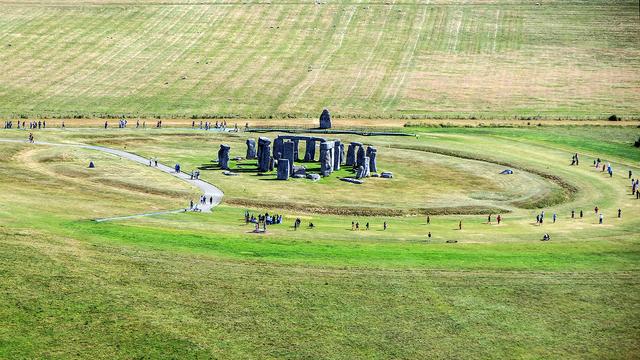
Ambivalent. But would like to get my drone up there. Although that would be limited to the south of the stones as they are bisected by a No Fly Zone.
Best way to avoid the crowds ! I got this from a light aircraft - followed by a hard 180° turn to clear Boscombe Down airspace.
| Re: Investigation into parking tickets for drivers queuing at petrol stations In "The Wider Picture in the United Kingdom" [377138/32243/51] Posted by Clan Line at 12:22, 17th July 2026 | |
It must be remembered that a lot of these private parking companies are just former cowboy clampers in a suit and tie.
I've never wavered in my opinion of private parking companies. Scum of the earth.
I've never wavered in my opinion of private parking companies. Scum of the earth.
Yes..............and No !
The basic problem is that for every "cowboy clamper" there is, there are thousands of "cowboy parkers". The current law is a mess because successive governments have tried to solve the parking problem with a one Law covers it all approach- it doesn't !! I live in an apartment block, we have 2 car parks and a Private approach road. All of these are fair game for a cowboys looking to park somewhere for free. The only legal solution we have is to employ a parking company. Some of which are undoubtedly run by get-rich- quick merchants.
If you own a house with front on-site parking there is nothing you can do to stop other people parking there - other than a gate, a chain or some other physical barrier. If they are already there, you are powerless until they drive away.
If we (where I live) were allowed to clamp people parking on our property, the problem could be solved almost over night. No money involved - just clamp them and greatly inconvenience the parking cowboy. The message would soon get home when people realise that the property owner can use clamps - or similar.
Of course the problem is not helped by local Councils continually reducing the roadside parking times and upping car park fees - and then outsource the parking control to a bunch of potential cowboys ...........but I won't do down that rabbit hole.
| Re: Local government reorganisation across Oxfordshire In "London to Didcot, Oxford and Banbury" [377137/32241/9] Posted by CyclingSid at 12:22, 17th July 2026 | |
... may have implications for transport, including rail, across the county. Article from the Oxford Clarion, which among other things wonders what now happens to the work done on the County Council's OxRAIL 2040 project.
Mark
https://oxfordclarion.uk/the-final-cut-its-three-councils/
Mark
https://oxfordclarion.uk/the-final-cut-its-three-councils/
If it happens West Berkshire will be happy that they don't have to have any connection with Reading. They probably moan that they didn't get there to include Swindon.
Can't many advantages to West Berks, it has been a unitary authority for over 30 years. Like the rest of Berkshire unitaries they were full of grand ideas until it cam to coughing up the money.
| Re: Stonehenge - Love it or hate it? In "The West - but NOT trains in the West" [377136/32211/31] Posted by Mark A at 12:21, 17th July 2026 | |
Think it was just about my only visit to Stonehenge, as a small child, despite the presence of the roads, the setting, sun-baked, impressed. As did, at one point, the passage overhead, low, of a large moth-shaped jet-powered aircraft, surreally thunderously skysplittingly noisy. I think I was about 14 before I heard something that loud again (a Lightning whose pilot saw fit to do a close pass across a Pembrokeshire hill-top...)
Mark
| Re: Stonehenge - Love it or hate it? In "The West - but NOT trains in the West" [377135/32211/31] Posted by CyclingSid at 12:14, 17th July 2026 Already liked by Mark A | |
Was posted to the Royal School of Artillery at Larkhill. Had never been to Stonehenge, rolled over in the morning and saw this thing poking out of the snow (remember that stuff) ain't it small. Well it was at that distance!
Being a typical drunken squaddy tended to be more interested in the "cultural" lure of the The Stones pub on the roundabout at Durrington.
Visits since, recommend looking at Woodhenge, especially if you have had a chance read about the context of the sites https://en.wikipedia.org/wiki/Woodhenge. Would also not recommend paying the price of an official visit to Stonehenge if you have been there before, walk down the footpath from the bus stop at Larkhill. You only end up being about 10m further from the stones.
Personally I find the area more atmospheric in a cold damp drizzle, probably an ex-sqaddy affliction by time spent on Salisbury Plain Training Area.
| Re: Stonehenge - Love it or hate it? In "The West - but NOT trains in the West" [377134/32211/31] Posted by Mark A at 11:53, 17th July 2026 | |
One great merit of stonehenge, is the debunking of American conspiracy theories. A common one is that the earth has tilted upon its axis, and that the tilt is worsening. This is proved by the many persons who claim the sun now shines through previously shaded windows.
May be answered by "In England we have a very ancient monument (much older than america). The sun still rises in the same position, relative to the stones, as it has done for thousands of years"
May be answered by "In England we have a very ancient monument (much older than america). The sun still rises in the same position, relative to the stones, as it has done for thousands of years"
This is good. Also looking forward to the long answer. :-)
Mark
| Re: King Charles III - becoming a proficient barman In "Introductions and chat" [377133/31289/1] Posted by Clan Line at 09:27, 17th July 2026 | |
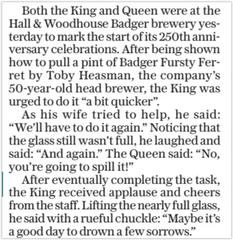
King Charles III is becoming a proficient barman:
Perhaps not ! Today's Telegraph............
| Re: Local government reorganisation across Oxfordshire In "London to Didcot, Oxford and Banbury" [377132/32241/9] Posted by Bob_Blakey at 09:26, 17th July 2026 Already liked by Mark A, Witham Bobby, eightonedee | |
Likewise Devonshire although we have raised Oxfordshire's plan by one council; Devon County Council and eight district councils together with the two existing unitary authorities - Plymouth & Torbay - are to be replaced by four new unitary authorities - 'Greater Exeter', 'Greater Plymouth', 'Greater Torbay' (I've no idea what they are actually going to be called) and Devon Coast & Countryside.
Personal Opinion Alert: I have always thought, and said so in the online consultation (using more polite language), that this was, is, and will remain a completely crap proposal. Largely driven by the self-serving administrations in Plymouth, Torbay & Exeter who were seemingly more interested in retaining their own influences rather than acting in the interests of all Devonians. I think this will lead to the three urban-centric authorities sucking up all the commercial & financial resources of Devonshire with the new Devon Coast & Countryside unit left to deal with the scraps of a largely rural community stretching from Ilfracombe (N) to Start Point (S) and Holsworthy (W) to Axminster (E), around 110 miles in each direction.
FWIW my view was that three unitary authorities centered around Exeter, Plymouth & Barnstaple would have been a better model, which would have allowed the total population of c. 1,260,000 to be split into three bits of roughly equivalent size. Does Torbay warrant being a unitary authority in it's own right? Nah!
| Re: Investigation into parking tickets for drivers queuing at petrol stations In "The Wider Picture in the United Kingdom" [377131/32243/51] Posted by Bob_Blakey at 08:07, 17th July 2026 | |
If the title of this thread is a true reflection of what is happening in some places on what planet is an 'investigation' required? Are we now being conditioned to not accept the evidence of our own eyes?
If it looks like a stalling tactic.....
| Re: Stonehenge - Love it or hate it? In "The West - but NOT trains in the West" [377130/32211/31] Posted by broadgage at 07:32, 17th July 2026 Already liked by Mark A, Western Pathfinder, Oxonhutch, rogerw, Marlburian, eightonedee | |
One great merit of stonehenge, is the debunking of American conspiracy theories. A common one is that the earth has tilted upon its axis, and that the tilt is worsening. This is proved by the many persons who claim the sun now shines through previously shaded windows.
May be answered by "In England we have a very ancient monument (much older than america). The sun still rises in the same position, relative to the stones, as it has done for thousands of years"
| Re: Swindon <-> Westbury service updates and amendments, ongoing discussion - 2026 In "TransWilts line - Swindon, Chippenham, Melksham, Trowbridge, Westbury, Salisbury" [377129/31359/18] Posted by grahame at 06:30, 17th July 2026 | |
20:06 Westbury to Cheltenham Spa due 22:06
Facilities on the 20:06 Westbury to Cheltenham Spa due 22:06.
This is due to more trains than usual needing repairs at the same time.
Will be formed of 2 coaches instead of 3.
Facilities on the 20:06 Westbury to Cheltenham Spa due 22:06.
This is due to more trains than usual needing repairs at the same time.
Will be formed of 2 coaches instead of 3.
| Re: Help shape the future of GWR travel In "Across the West" [377128/32240/26] Posted by Trowres at 23:34, 16th July 2026 Already liked by Mark A | |
Whether it’s the ease of booking, the comfort of your seat, the confidence in your journey, or even what happens after you step off the train — we want to hear about it.
I can't help wondering how the customer profiling in the questions asked will be mapped onto the issues raised in the opening quotation.
| Re: Andy Burnham elected to parliament, with a strong transport reputation In "Looking forward - the next 2, 5, 10 and 20 years" [377127/32149/40] Posted by JayMac at 22:39, 16th July 2026 | |
Wait seven decades for a coronation, then two come along in three years
Yep. Labour 2026. LibDems 2024.
Three in the last four years if we include the Conservatives in October 2022.
Four in the last four years if you include Charles III.
If we're just looking at the top three (based on number of MPs) Westminster parties, they've changed leaders unopposed five times in the 21st century.
If we include Scottish, Welsh, Northern Irish and smaller parties then there have been at least 28 coronations in the 21st century. Theresa May was half coronated in 2016. She won the first ballot of Conservative MPs with all other candidates withdrawing before the wider membership voted.
Incidentally, the Liberal Democrats have to have a leadership election in the first year after every General Election. It's in their constitution.
| Re: King Charles III - becoming a proficient barman In "Introductions and chat" [377126/31289/1] Posted by JayMac at 22:07, 16th July 2026 | |
King Charles III is becoming a proficient barman: a video news report, from the BBC, at https://www.bbc.co.uk/news/videos/c74gl17w1y2o
It's a video news item, so you'll need to click on that link to the BBC to enjoy it.
It's a video news item, so you'll need to click on that link to the BBC to enjoy it.
Proficient? Still some way to go, Brian. The tide was out further on that pint than low tide at Weston-super-Mare!
You lower the glass down the swan neck as you reach the end of the main pour (displacement innit?) with one small final pull, with the sparkler just below the head, to top the ale off. Some ales benefit from a 60 second rest after the main pour for head formation.
JayMac: Bass Cellarman certificate awarded 1990. All my own work. I didn't have a wife 'helping'.
| Re: Help shape the future of GWR travel In "Across the West" [377125/32240/26] Posted by WelshBluebird at 22:00, 16th July 2026 Already liked by Phil, Mark A | |
I don't think the wording of that fourth question was proof read!
| Re: Investigation into parking tickets for drivers queuing at petrol stations In "The Wider Picture in the United Kingdom" [377124/32243/51] Posted by JayMac at 21:43, 16th July 2026 Already liked by Western Pathfinder, Oxonhutch, Fourbee, broadgage | |
It must be remembered that a lot of these private parking companies are just former cowboy clampers in a suit and tie. Trying and failing to police themselves through independent (yeah right) appeals services. They have zero interest in getting their house in order as that doesn't bring in the moolah. You can be charged more for an alleged parking contract breach than court fines for a crime against the person.
I've never wavered in my opinion of private parking companies. Scum of the earth. That said, I'd like them to continue their shady practices for the moment. Because, like clamping on private land, legislation will finally catch up with them and put them out of business. As a start, local councils should be given the power to insist (through Section 106 orders) that new developments with public access car parks are not permitted to have third party parking 'management'. The landlord and/or tenant must do it themselves.
| Re: King Charles III - becoming a proficient barman In "Introductions and chat" [377123/31289/1] Posted by Oxonhutch at 21:38, 16th July 2026 Already liked by Mark A, Witham Bobby | |
King Charles III is becoming a proficient barman ...
A skill learned early on being a student geologist. Honed in my late student career when a large accounting company's recruitment event organiser closed the evening bar by the (they thought) simple expedient of removing the hotel barman.
I have to say, by the time I was rumbled, the CEO was hammered. Ooops !!
Happy days ...
| Re: Help shape the future of GWR travel In "Across the West" [377122/32240/26] Posted by Oxonhutch at 21:27, 16th July 2026 | |
Just arrived in my inbox from GWR
| Re: Preston, Lancashire: woman dead, girl, 8, injured as train hits car at Hoghton In "The Wider Picture in the United Kingdom" [377121/32170/51] Posted by Oxonhutch at 21:22, 16th July 2026 | |
Not far from where I grew up.
This sounds horribly like a wrong-side failure on the railway from the words given in the report.
| OTD - On This Day, 16 July (1965) - Mont Blanc Tunnel opened In "The Wider Picture Overseas" [377120/32244/52] Posted by Chris from Nailsea at 18:49, 16th July 2026 | |
From Wikipedia, see https://en.wikipedia.org/wiki/Mont_Blanc_Tunnel
| Re: Preston, Lancashire: woman dead, girl, 8, injured as train hits car at Hoghton In "The Wider Picture in the United Kingdom" [377119/32170/51] Posted by stuving at 18:27, 16th July 2026 | |
The RAIB's preliminary statement on this accident says that they believe the crossing warnings and barriers had not operated by the time the train arrived. We must await the results of the investigation to find out why.
At around 08:48 on 25 June 2026, the 07:51 Northern passenger service from Colne to Preston struck a car on Hoghton automatic half-barrier level crossing, which is situated between Preston and Blackburn. The driver of the car was fatally injured in the accident and a child who was a passenger in the car was also seriously injured. No injuries were caused to anyone on the train.
Hoghton level crossing is equipped with road traffic lights and an audible alarm for pedestrians, both of which are designed to activate automatically as trains approach. A short time after the lights and alarm activate, half- barriers at both sides of the crossing will automatically lower, to block the left-hand side of the road.
The evidence available to RAIB shows that the train had passed a green (proceed) signal as it approached the crossing. RAIB’s preliminary examination also found that the road traffic lights and audible alarm at the crossing had not been activated, and that the half-barriers were raised.
Our investigation will determine the sequence of events that led to the accident and will include consideration of:
the actions of those involved and any factors that may have influenced them
any previous incidents at Hoghton level crossing
the management of risk at this crossing
any relevant underlying factors.
Our investigation is independent of any investigation by the railway industry or by the industry’s regulator, the Office of Rail and Road.
We will publish our findings, including any recommendations to improve safety, at the conclusion of our investigation. This report will be available on our website.
Hoghton level crossing is equipped with road traffic lights and an audible alarm for pedestrians, both of which are designed to activate automatically as trains approach. A short time after the lights and alarm activate, half- barriers at both sides of the crossing will automatically lower, to block the left-hand side of the road.
The evidence available to RAIB shows that the train had passed a green (proceed) signal as it approached the crossing. RAIB’s preliminary examination also found that the road traffic lights and audible alarm at the crossing had not been activated, and that the half-barriers were raised.
Our investigation will determine the sequence of events that led to the accident and will include consideration of:
the actions of those involved and any factors that may have influenced them
any previous incidents at Hoghton level crossing
the management of risk at this crossing
any relevant underlying factors.
Our investigation is independent of any investigation by the railway industry or by the industry’s regulator, the Office of Rail and Road.
We will publish our findings, including any recommendations to improve safety, at the conclusion of our investigation. This report will be available on our website.
