







| Finland - railway issues and developments - merged topics Posted by Chris from Nailsea at 18:27, 4th January 2010 |     |
From the BBC:
An intercity train carriage has barged through the end of a railway platform crashing into the hallway of a hotel at Helsinki Railway station.
The train carriage, which had faulty brakes, travelled through a concrete barrier at the end of platform before crashing into the Holiday Inn Hotel.
The train carriage, which had faulty brakes, travelled through a concrete barrier at the end of platform before crashing into the Holiday Inn Hotel.
| Re: Train crashes into hotel at Helsinki Railway Station Posted by Worcester_Passenger at 19:24, 4th January 2010 | |
And it seems to have happened on platform 13. Spooky or what, possums?
| Re: Train crashes into hotel at Helsinki Railway Station Posted by Phil at 19:58, 4th January 2010 | |
Couple of queries from a born pedant - I thought the term "Intercity" was a British Railways trademark, in which case what was a 40 year old 125 doing in Helsinki in the first place - and how did a train carriage "barge through" without being either pulled or pushed by a locomotive?
| Re: Train crashes into hotel at Helsinki Railway Station Posted by JayMac at 20:07, 4th January 2010 | |
The report states that 4 carriages broke free from the consist as it reversed. As it was an empty train I guess the carriages were either being shunted or an ECS movement. Don't know much about Finnish rolling stock but it is surpising that an accidentally divided train doesn't have fail-safe brakes.
| Re: Train crashes into hotel at Helsinki Railway Station Posted by willc at 23:01, 4th January 2010 | |
I thought the term "Intercity" was a British Railways trademark
Only in the UK - and of course while most of the rest of Europe's railways cottoned on to it as a handy term to use for major express services and use it to this day, especially Germany, it died a death here thanks to privatisation. The initial incarnation of post-privatisation Great Western being the last operator to use the Intercity brand on its trains.
| Re: Train crashes into hotel at Helsinki Railway Station Posted by Phil at 07:45, 5th January 2010 | |
I thought the term "Intercity" was a British Railways trademark
Only in the UK
Exactly. Thankyou for bearing out my point, Willc.
Here in the UK the term "Intercity" still carries a resonance with the majority of the travelling pubic. Certainly the BBC of all people ought to be familiar with the usage. Careless journalism, mindless of the target audience. Tsk.
| Re: Train crashes into hotel at Helsinki Railway Station Posted by Tim at 09:28, 5th January 2010 | |
I thought the term "Intercity" was a British Railways trademark
The UK trademark for the word "intercity" in connection with passenger rail transport (Trade Mark 1277000) is currently owned by the Secreatry of State for Transport. Presumably he inherited from BR. Trademarks are vunerable to loss if they are not used, one wonders if Intercity is currently being used enough to justify its retention on the trademark register.
| Re: Train crashes into hotel at Helsinki Railway Station Posted by willc at 10:12, 5th January 2010 | |
I thought the term "Intercity" was a British Railways trademark
Only in the UK
Exactly. Thankyou for bearing out my point, Willc.
Here in the UK the term "Intercity" still carries a resonance with the majority of the travelling pubic. Certainly the BBC of all people ought to be familiar with the usage. Careless journalism, mindless of the target audience. Tsk.
Ha, ha. I almost died laughing. But it shows what an utter shambles privatisation was that such an obvious and widely understood brand was just allowed to disappear from use in the country that coined it.
| Sweden reopens to the Finnish border Posted by grahame at 07:46, 15th April 2021 | |
From Railway Gazette
SWEDEN: Passenger services have been reinstated on the 159 km route between Boden and Haparanda on the border with Finland.
Regular passenger services on the line had ended in 1992, but have now restarted with Vy Tåg’s Norrtåg subsidiary initially operating two return trains a day from Luleå to Haparanda and a single pair of trains between Umeå and Haparanda, using two-car Bombardier Regina X52 EMUs.
The only stop between Haparanda and Boden is at Kalix, where a new station has been built, while the old station at Haparanda has been refurbished.
Regular passenger services on the line had ended in 1992, but have now restarted with Vy Tåg’s Norrtåg subsidiary initially operating two return trains a day from Luleå to Haparanda and a single pair of trains between Umeå and Haparanda, using two-car Bombardier Regina X52 EMUs.
The only stop between Haparanda and Boden is at Kalix, where a new station has been built, while the old station at Haparanda has been refurbished.
Looks like joined up thinking. I find myself asking
- I wonder if this is as expensive per mile as Ashington or Okehampton
- What a contrast to Ireland where Rosslare to Waterford is in danger of being ripped up
- Do Finnish passenger trains run to the border?
| Re: Sweden reopens to the Finnish border Posted by Lee at 10:45, 15th April 2021 | |
From Railway Gazette
Looks like joined up thinking. I find myself asking
- I wonder if this is as expensive per mile as Ashington or Okehampton
- What a contrast to Ireland where Rosslare to Waterford is in danger of being ripped up
- Do Finnish passenger trains run to the border?
SWEDEN: Passenger services have been reinstated on the 159 km route between Boden and Haparanda on the border with Finland.
Regular passenger services on the line had ended in 1992, but have now restarted with Vy Tåg’s Norrtåg subsidiary initially operating two return trains a day from Luleå to Haparanda and a single pair of trains between Umeå and Haparanda, using two-car Bombardier Regina X52 EMUs.
The only stop between Haparanda and Boden is at Kalix, where a new station has been built, while the old station at Haparanda has been refurbished.
Regular passenger services on the line had ended in 1992, but have now restarted with Vy Tåg’s Norrtåg subsidiary initially operating two return trains a day from Luleå to Haparanda and a single pair of trains between Umeå and Haparanda, using two-car Bombardier Regina X52 EMUs.
The only stop between Haparanda and Boden is at Kalix, where a new station has been built, while the old station at Haparanda has been refurbished.
Looks like joined up thinking. I find myself asking
- I wonder if this is as expensive per mile as Ashington or Okehampton
- What a contrast to Ireland where Rosslare to Waterford is in danger of being ripped up
- Do Finnish passenger trains run to the border?
The Haparanda Line is quoted above as being 159km, or roughly 99 miles long. The cost of reintroduction of passenger services is quoted as being SKr 50m, or nearly £4.3 million at today's exchange rate, or nearly £43k per mile - see https://www.railjournal.com/regions/europe/new-start-for-passenger-trains-in-the-north/ for more details.
The reopened Ashington line will be around 18 miles long. The cost of reintroduction of passenger services is quoted as being £166 mliion, or around £9.2 million per mile - see https://www.northumberlandgazette.co.uk/news/politics/council/government-confirms-ps34million-northumberland-line-rail-minister-says-hes-lucky-be-reopening-train-lines-3110263 for more details.
The soon to be reopened Okehampton line is officially quoted as being 14 miles long by Network Rail. The cost of reintroduction of passenger services is quoted as being £40.5 mliion, or around £2.9 million per mile - see https://www.railjournal.com/passenger/main-line/first-line-to-reopen-under-british-restoration-fund-announced/ for more details.
Proposals to expand Ireland's public transport network never really recovered from the cancellation of the Transport 21 project in May 2011 - see https://en.m.wikipedia.org/wiki/Transport_21 for more details.
Finnish passenger trains do run to Kolari, on the border with Sweden - see https://en.m.wikipedia.org/wiki/Kolari_railway_station for more details.
Hope that helps

| Re: Sweden reopens to the Finnish border Posted by ellendune at 20:23, 15th April 2021 | |
Well it rather depends on what needs doing to reopen the line.
One might ask:
- Is it already open for regular freight?
- What speed was freight allowed to go and what speed is required for passenger use?
- How different are the maintenance standards for freight and passenger lines in Sweden?
- Will there be capacity issues?
Okehampton had not been used much recently and had been somewhat neglected.
I do not know much about the Ashington line
| Re: Sweden reopens to the Finnish border Posted by Lee at 20:54, 15th April 2021 | |
Well it rather depends on what needs doing to reopen the line.
One might ask:
Okehampton had not been used much recently and had been somewhat neglected.
I do not know much about the Ashington line
One might ask:
- Is it already open for regular freight?
- What speed was freight allowed to go and what speed is required for passenger use?
- How different are the maintenance standards for freight and passenger lines in Sweden?
- Will there be capacity issues?
Okehampton had not been used much recently and had been somewhat neglected.
I do not know much about the Ashington line
All good questions.
I just restricted myself to providing the figures. I assumed grahame had a good reason for asking which I am sure he will reveal in due course
| Re: Sweden reopens to the Finnish border Posted by stuving at 22:42, 15th April 2021 | |
Well it rather depends on what needs doing to reopen the line.
One might ask:
One might ask:
- Is it already open for regular freight?
- What speed was freight allowed to go and what speed is required for passenger use?
- How different are the maintenance standards for freight and passenger lines in Sweden?
- Will there be capacity issues?
The line had a major upgrade in 2008-12, including a 40 km long short cut of brand new track, electrification, and ETCS/ERTMS. That was for freight usage, described in the supporting EU project as part of TEN-T and being multimodal. No doubt there is some local traffic too, if only trees.
You might think that was done with one eye on passenger services too, but I can't see any sign that was important in justifying the money. Basically there is one thing missing from this part of the world - people. But I'm sure a couple of passenger trains a day won't be a problem, provided they don't get in the way of the more important trains.
| Re: Sweden reopens to the Finnish border Posted by ellendune at 23:42, 15th April 2021 | |
The line had a major upgrade in 2008-12, including a 40 km long short cut of brand new track, electrification, and ETCS/ERTMS. That was for freight usage, described in the supporting EU project as part of TEN-T and being multimodal.
The Haparanda Line is quoted above as being 159km, or roughly 99 miles long. The cost of reintroduction of passenger services is quoted as being SKr 50m, or nearly £4.3 million at today's exchange rate, or nearly £43k per mile - see https://www.railjournal.com/regions/europe/new-start-for-passenger-trains-in-the-north/ for more details.
So we need to add in another €47,000,000 from that project to the £4.3 mentioned above. It still suggests it was far from being in the run down state of the Oakhampton line.
| Re: Sweden reopens to the Finnish border Posted by grahame at 06:40, 16th April 2021 | |
I just restricted myself to providing the figures. I assumed grahame had a good reason for asking which I am sure he will reveal in due course 
"Low-level" type question - looking to help fill (me) in on the relative costs of re-openings in the UK and elsewhere. It does seem / sound like the Swedish case (in cost per km) was relatively cheap compared to the active schemes in the UK at the moment to bring passenger trains back to lines without any regular passenger trains.
I have learned that there is no special / easy-cheap way that the Swedes are doing it - rather a line than was already virtually up to it. Ah well - it was worth looking. Looking for a UK comparison - nothing comes straight to my mind as a long line in fine, modern fettle, though there are some short sections around.
Around my home area, Westbury North to East curve comes to mind, where a service was tried out a few years ago under "experimental" regulations. Just one train (initially each way?) per day, it was rather quiet when I caught it and (I believe) it was withdrawn to stop it being reclassified as permanent and requiring a formal closure process if it has stayed but then been withdrawn later. The alternative (now-ish) running reverses at Westbury rather than taking the curve.
Aside - I am not suggesting that the Westbury experiment was a failure as such; the trains in question provided (and now modified, provide) a Bradford-on-Avon and Trowbridge to Paddington direct round trip for London meetings (far too slow to use on a daily basis) as part of what was running anyway - getting a service that started its day and ended it otherwise at Pewsey to / from the depot. I was considering for today a trip out from Melksham to either Pewsey of Bedwyn and cycling back, but journey times of 100 minutes to Pewsey on all morning services, and up to 180 minutes to Bedwyn put me off. Doesn't have to be an obviously-silly journey (Whitby to Scarborough, or Blaenau Ffestiniog to Harlech) to take a silly-long time.
| Re: Sweden reopens to the Finnish border Posted by ellendune at 08:59, 16th April 2021 | |
The culture of cost cutting by government imposed cuts by BR has left a huge legacy on our railways. Top down cuts were imposed and BR therefore became adept at finding ways to reduce costs. It is clear that the underlying assumption that railways were a thing of the past was not only in the mind set of the politicians but many senior managers at BR as well.
Reducing a double track line to single not only saved the costs of relaying one line and the future day to day maintenance of that track, but also, by slewing the remaining line into the middle allowed then to delay earthworks maintenance. A low speed goods line could be easily neglected as obviously if it was only goods it would be destined for closure soon, was presumably the thinking.
This is essential work that is not obvious to the general public, but its past neglect is haunting Network Rail (NR) now, not just on minor good lines. It is obvious if you do not repaint a steel bridge it will deteriorate, but embankments and cuttings are seen as maintenance free, when they are far from being so. The clay soils that predominate in many parts of the UK especially southern England are notorious. Brunel was delayed in opening the link from Farringdon Road (later Challow station) to Chippenham by 18 month, by the challenge of building embankments with these clays and the Swindon section of the caused major problems in building the Gloucester line.
With some exceptions a goods line in the UK is typically the last leg of a journey with an infrequent service (the intensively used quarry and (previously) coal line were well maintained) poorly were neglected. I don't know if railway administrations on the continent similarly neglect such routes, but the line in Sweden in the OP, was an international freight route that goes through an area with little population so obviously had a future. I am not sure of the geology but it may have rock embankments rather than clay which can be easier to maintain.
Comparing costs on a benchmark per km basis is a technique used by economists who know little or nothing of engineering to provide ammunition to politicians who are entranced by the idea that "efficiency savings" can allow them to say they are spend more while doing the opposite so they can also cut taxes. They fail to realise that it is their own policies past and present that have created many of the inefficiencies that therefore cannot be tackled because they are the problem. Having a steady pipeline of electrification work would cut the costs per km significantly but if you have a new team each time who have to learn on the job you will never do it efficiently.
Similarly some requirements imposed by DfT on HS2 to minimise future maintenance have massively increased the cost of construction. I am sure these will be revisited in later stages, but for stage 1 they are now fixed into the project. Why was no engineer on the project at an early stage empowered to question these requirements or did the design while you construct culture (don't get me on that) that we so like in this country these days blind even them to the implications of that decision.
Edit: VickiS - Clarifying Acronym
| Re: Sweden reopens to the Finnish border Posted by grahame at 05:47, 14th April 2026 | |
From Railway Gazette
SWEDEN: Passenger services have been reinstated on the 159 km route between Boden and Haparanda on the border with Finland.
Regular passenger services on the line had ended in 1992, but have now restarted with Vy Tåg’s Norrtåg subsidiary initially operating two return trains a day from Luleå to Haparanda and a single pair of trains between Umeå and Haparanda, using two-car Bombardier Regina X52 EMUs.
The only stop between Haparanda and Boden is at Kalix, where a new station has been built, while the old station at Haparanda has been refurbished.
Regular passenger services on the line had ended in 1992, but have now restarted with Vy Tåg’s Norrtåg subsidiary initially operating two return trains a day from Luleå to Haparanda and a single pair of trains between Umeå and Haparanda, using two-car Bombardier Regina X52 EMUs.
The only stop between Haparanda and Boden is at Kalix, where a new station has been built, while the old station at Haparanda has been refurbished.
I visited this line Interrail in 2024 ... the single daily train to Tornio station in Finland, walk to Haparanda, and train onward. Will be good to see oil opened through.
From yle in Finland
Starting this summer, railway afficionados will be able to make a record-long train journey within the EU.
And for those seeking the old-time romance of the rails, the key to the new route is a evocatively restored station in Haparanda, Sweden, dating back to 1919.
When a long-awaited rail link opens between northern Finland and Sweden, it will be possible to travel some 5,000km by train from Portugal's Algarve to Kolari in Lapland – Finland's northernmost station.
And for those seeking the old-time romance of the rails, the key to the new route is a evocatively restored station in Haparanda, Sweden, dating back to 1919.
When a long-awaited rail link opens between northern Finland and Sweden, it will be possible to travel some 5,000km by train from Portugal's Algarve to Kolari in Lapland – Finland's northernmost station.
| Re: Finland - railway issues and developments - merged topics Posted by grahame at 13:57, 10th August 2026 | |
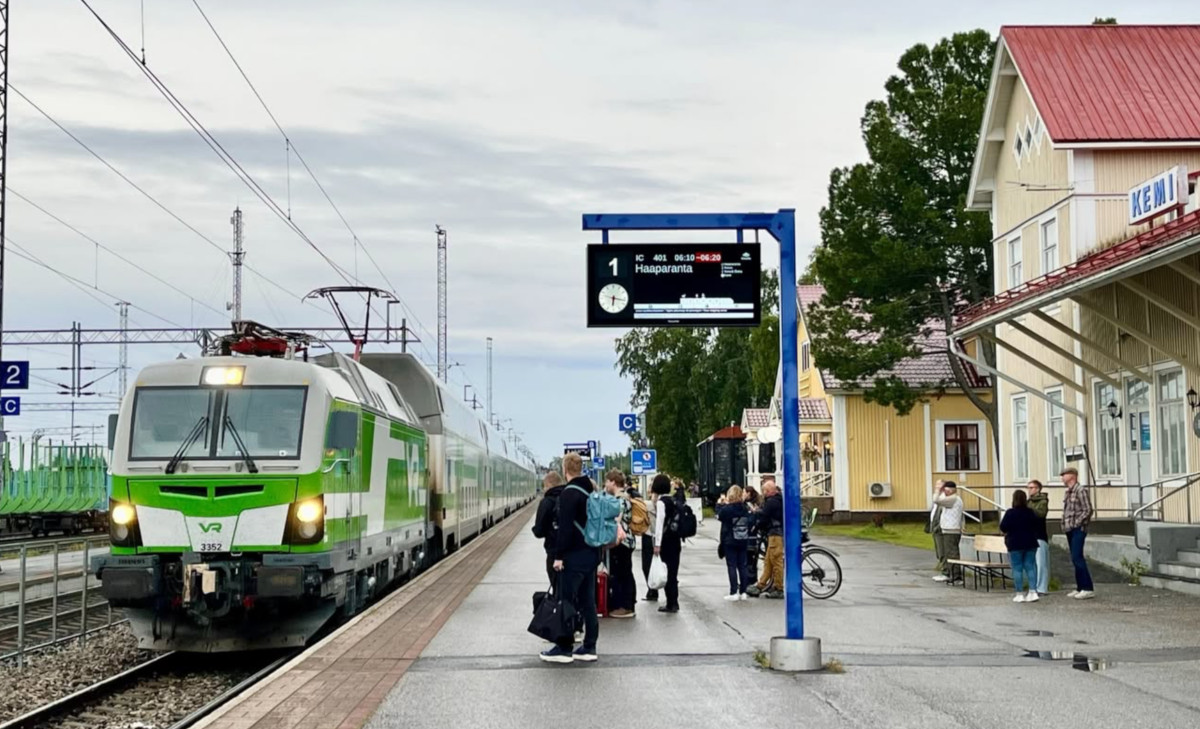
First train this morning