









| Aberthaw Power Station and Decarbonisation Posted by SandTEngineer at 16:02, 13th December 2019 |     |
Aberthaw, the last coal fired power station in Wales, ceased production at 1530 today (Friday 13/12/2019) with the likely loss of 170 jobs over the next few months.
End of another era........
| Re: Aberthaw Power Station Posted by broadgage at 17:46, 13th December 2019 | |
Poor timing IMHO, I can see the need to reduce carbon emissions by reducing and then eliminating coal burning.
But it might have made more sense to keep the power station operational until the end of this winter for "just in case".
By NEXT winter we should have more renewable capacity, and it is uneconomic to keep aging coal burning plant on standby for years, but a few weeks might have been prudent.
Especially as both reactors at Hunterston B wont be available for this winter.
| Re: Aberthaw Power Station Posted by stuving at 19:25, 13th December 2019 | |
Especially as both reactors at Hunterston B wont be available for this winter.
Not to mention the risk of a large drop in French production. So far workers in the electricity and gas industries have been kept out of the brouhaha about pensions, though in the long term the plan is for them to lose their special pension schemes just like the railway workers. Apparently (and I've not found a source of data to check these figures) there is a loss of about 1.5 GW most days, but France is, surprisingly, not consistently a nett exporter these days in any case.
| Re: Aberthaw Power Station Posted by broadgage at 09:59, 14th December 2019 | |
Agree.
BTW, French electricity production data may be found here;
https://www.gridwatch.templar.co.uk/france/
| Re: Aberthaw Power Station Posted by stuving at 10:56, 14th December 2019 | |
Agree.
BTW, French electricity production data may be found here;
https://www.gridwatch.templar.co.uk/france/
BTW, French electricity production data may be found here;
https://www.gridwatch.templar.co.uk/france/
I've worked out why the data I had found from Réseau de Transport d’Electricité (RTE) were inconsistent (with themselves and that Gridwatch panel) - I was in the bit of the Réseau de Transport d’Electricité (RTE) site for energy traders. That deals in energy flow predictions (updated until they become actual and then they disappear), and without links to their real-time data.
There is a link on Gridwatch to RTE's pretty presentation graphs, which show that when wind power is "on" RTE exports all day: from zero at their peak demand up to 6 GW. There is also about 6 GW of pumped storage, but with peak-trough of 15-20 GW more is needed.
So there are huge swings, notably when French generation is low for whatever reason. For some that's known (calm, shut-downs, strikes...) but Réseau de Transport d’Electricité (RTE) also talk about "the normal operation of the energy market"; I presume that means importing (mostly German windpower) when it's cheaper than what EDF can turn off.
Edit: VickiS - Clarifying Acronym
| Re: Aberthaw Power Station Posted by SandTEngineer at 12:04, 14th December 2019 | |
According to info elsewhere that now leaves the following UK coal fired power stations:
Drax (what hasn't been converted to biomass)
Fiddler's Ferry
Kilroot
Ratcliffe-on-Soar
West Burton
Fiddler's Ferry next to go in 3 months time.
| Re: Aberthaw Power Station Posted by didcotdean at 12:11, 14th December 2019 | |
At this moment, despite UK wind being not far off the peak (~12GW/33%) and ~2.25 GW/6.25% from solar, imports are maxed out on 4 out of the 5 interconnectors (~5.5GW/13%). Still it is giving the gas plant a bit of a rest as it is at only around 50% of capacity.
| Re: Aberthaw Power Station Posted by broadgage at 13:12, 14th December 2019 | |
I know someone whom works at a power station that receives extra payments from National Grid for being capable of a "black start"
Most power stations require an external source of electricity to run auxiliary plant before electricity can be produced. This is normally obtained from the transmission system.
A minority of power stations have black start capability whereby they can be started up without any external power.
The basic requirements are the ability to start at least one main generating unit/module within a specified time, and to do this at least three times, in case the grid fails before the plant is running, and once running to accept large step changes in load.
This is usually achieved by diesel engines that start from air bottles or batteries, in order to run essential equipment.
The most recent test of the black start capability was a failure.
| Re: Aberthaw Power Station Posted by stuving at 00:12, 16th October 2020 | |
At this moment, despite UK wind being not far off the peak (~12GW/33%) and ~2.25 GW/6.25% from solar, imports are maxed out on 4 out of the 5 interconnectors (~5.5GW/13%). Still it is giving the gas plant a bit of a rest as it is at only around 50% of capacity.
Apparently, the latest cross-channel interconnector "launched" today - i.e. it has just started its commissioning. This is IFA-2; the oldest link is IFA (for Interconnexion France-Angleterre), and both were built by the two electricity network operators jointly (NG and RTE). This end of it is partly at Solent Airport (was Lee-on-the-Solent, or Daedelaus to its friends) and partly just along the coast at Chilling near Warsash.
It adds another 1 GW to the existing 2 GW of IFA, and 1 GW each for Nedlink (Netherlands) and NEMO (Belgium). But more capacity linking to France is being built, in the form of Eleclink (1 GW via the tunnel), and in planning are FAB Link (1.4 GW via Alderney to Exeter) and AQUIND (2 GW into Portsmouth). AQUIND is currently with the planning inspectors, and was recently in the news for wanting to dig a trench through part of the city for its cables - which, oddly, wasn't popular.
| Re: Aberthaw Power Station Posted by broadgage at 05:54, 16th October 2020 | |
Such interconnectors give most useful flexibility in case of breakdowns or other out of course events.
They also increase the opportunity to use renewable energy, it is always windy somewhere in Europe.
Adding Norwegian hydroelectric power to the European energy market is particularly helpful. Norway can export hydropower to us during calm weather, and we can export UK wind power to Norway in windy conditions, thereby reducing the demand for hydropower and leaving more water in dams for future use.
My only reservation is that more interconnectors might become an excuse for not ensuring adequate UK generating capacity. We should in my view aim to export electricity on at least a similar scale to that which we import.
Interconnectors can break, and other nations might suffer shortages that limit exports to the UK.
Electricity demand in the UK has fallen in recent years due to energy saving regulations (most of which were bitterly opposed).
I expect demand to increase in the future for several reasons.
1) A growing population.
2) Increased use of electric transport.
3) A move towards electric heating, particularly in privately rented homes.
4) Mains operated smoke detectors in most new properties, only 1 watt each, but a not quite negligible extra demand of perhaps 50 million watts in total (10 million homes, 5 smoke detectors in each, 50 million 1 watt loads) 50 Mw is about an extra 0.1% on the peak demand.
5) Future requirements to fit emergency lighting to homes, initially only for vulnerable groups, (1 million homes, 20 watts in each of these homes, another 20 Mw.
6) A warming climate increasing the demand for air conditioning, and also increasing the energy used by existing refrigeration equipment.
And whilst energy saving is commendable, it wont carry on reducing demand indefinitely. Much of the "low hanging fruit" has already been plucked.
Take lighting as an example. Replacing a 60 watt incandescent lamp with a 12 watt CFL saves 48 watts. Replacing the 12 watt CFL with a 6 watt LED saves a useful but rather less impressive 6 watts. Replacing the 6 watt LED with a 3 watt LED (not yet available in the UK) Saves a paltry 3 watts, better than not saving 3 watts but hardly dramatic.
And NO lamp with a light equal to a 60 watt incandescent can EVER use less than about 2 watts, and I suspect that 3 watts might be as good as it will get.
| Re: Aberthaw Power Station Posted by Electric train at 21:01, 16th October 2020 | |
Such interconnectors give most useful flexibility in case of breakdowns or other out of course events.
They also increase the opportunity to use renewable energy, it is always windy somewhere in Europe.
They also increase the opportunity to use renewable energy, it is always windy somewhere in Europe.
The downside to the both the interconnectors and renewables (wind and solar) is the lack of inertia they provide to the Grid. The inertia in the system used to be the spinning mass of the large alternators and turbines, the interconnectors as DC with inverters, the wind turbines use static frequency converters and solar is also DC with inverters
The lack of inertia manifest itself in a number of ways, one is under fault conditions, like the August 2019 event, the 400kV system voltage looses stability for longer before it recovers; the major impact though caused by the lack of inertia is poor power factor, this causes me issues in my day job when we need to parallel two grid supply points and some harmonic issues.
I'm not knocking the interconnectors or renewables, its just our National Grid and all the local Distribution Networks was engineered for large bulk rotating machine generation
| Re: Aberthaw Power Station Posted by onthecushions at 11:02, 17th October 2020 | |
Perhaps renewable sources need the same as UPS systems used to have; large motor/alternator sets running continuously.
There's a small energy (and cost) penalty but that's just part of the joy of sustainability.
It might even make re-newables more useful/marketable as a consistent energy supply.
OTC
| Re: Aberthaw Power Station Posted by ellendune at 12:38, 17th October 2020 | |
Perhaps renewable sources need the same as UPS systems used to have; large motor/alternator sets running continuously.
There's a small energy (and cost) penalty but that's just part of the joy of sustainability.
It might even make re-newables more useful/marketable as a consistent energy supply.
OTC
Other solutions are being found including flywheels in Scotland
| Re: Aberthaw Power Station Posted by broadgage at 14:05, 17th October 2020 | |
The downside to the both the interconnectors and renewables (wind and solar) is the lack of inertia they provide to the Grid. The inertia in the system used to be the spinning mass of the large alternators and turbines, the interconnectors as DC with inverters, the wind turbines use static frequency converters and solar is also DC with inverters
The lack of inertia manifest itself in a number of ways, one is under fault conditions, like the August 2019 event, the 400kV system voltage looses stability for longer before it recovers; the major impact though caused by the lack of inertia is poor power factor, this causes me issues in my day job when we need to parallel two grid supply points and some harmonic issues.
I'm not knocking the interconnectors or renewables, its just our National Grid and all the local Distribution Networks was engineered for large bulk rotating machine generation
Yes, could not have put it better myself.
But in fact the position is worse than suggested above, generation connected via static inverters, and imports also connected via static inverters do suffer from lack of inertia as described above.
Also, an increasing percentage of the electrical load these days consists of switched mode power supplies*. These often work correctly down to 85 or 90 volts.
Suppose that some transient fault or failure briefly reduces the nominal 230 volt supply to 115 volts. Back in the old days, most loads would use less current at this temporarily reduced voltage, this helped the system to recover from the fault.
These days, the load current will roughly double at the reduced voltage, this increased current will tend to further reduce the voltage, and in extreme cases might lead to a total failure.
During the 1970s power shortages, as well as rota power cuts, voltage reductions were imposed to reduce the load. This works less well today as all those switched mode* power supplies will draw constant watts at the reduced voltage.
*electronic lighting ballasts, electric vehicle chargers, most consumer electronics, variable speed motor drives, and modern electric trains/trams, are all examples of switched mode power supplies.
| Re: Aberthaw Power Station Posted by broadgage at 14:33, 17th October 2020 | |
Perhaps renewable sources need the same as UPS systems used to have; large motor/alternator sets running continuously.
There's a small energy (and cost) penalty but that's just part of the joy of sustainability.
It might even make re-newables more useful/marketable as a consistent energy supply.
OTC
Other solutions are being found including flywheels in Scotland
Flywheels cant store enough energy to compensate for calm weather and limited power availability.
They are however very helpful by adding inertia and thereby promoting stability, I expect more schemes similar to the one in the above link.
| Re: Aberthaw Power Station Posted by mjones at 14:43, 17th October 2020 | |
Some of the more unusual methods being proposed to store surplus renewable energy should help in that respect, for example as liquified air that would drive a turbine and heavy weights pulled up and down mine shafts by motor/generators. However other methods like hydrogen electrolysis and large flow batteries will have the problem you describe.
| Re: Aberthaw Power Station Posted by stuving at 16:01, 17th October 2020 | |
Perhaps renewable sources need the same as UPS systems used to have; large motor/alternator sets running continuously.
There's a small energy (and cost) penalty but that's just part of the joy of sustainability.
It might even make re-newables more useful/marketable as a consistent energy supply.
OTC
Other solutions are being found including flywheels in Scotland
Flywheels cant store enough energy to compensate for calm weather and limited power availability.
They are however very helpful by adding inertia and thereby promoting stability, I expect more schemes similar to the one in the above link.
You don't need to - this contract was one of five signed by NG-ESO in January. They are paying for a service (presently called synchronous compensation), ?328M over six years. It is up to the contractors to find the capital cost. Together they provide 12.5 GWs of inertia - the grid had 300 not long ago, now has 100-200 depending on the connected plant mix (which is seasonal) and will soon be below 100 some of the time. So this is only a part of the solution.
In addition to that Statkraft one, there is another new one in Wales and three using existing things as flywheels. On is a turbine at Cruachan, operated by Drax. Uniper are using two old power station turbines at Killingholme, and building two new SCs at Grain. Triton are providing this service at Indian Queens (near St Dennis) - of which they say this:
Indian Queens Power Station is an OCGT (Open Cycle Gas Turbine) power station located in Cornwall. The station has an output capacity of 140 MW providing voltage support to the UK electricity market as part of an ancillary services contract with National Grid.
The turbine drives an air cooled generator through an SSS (Synchro Self Shifting) clutch which allows the plant to operate as a synchronous compensator when required. The power plant operates at peak times when power demand is high.
The turbine drives an air cooled generator through an SSS (Synchro Self Shifting) clutch which allows the plant to operate as a synchronous compensator when required. The power plant operates at peak times when power demand is high.
Synchronous compensators (a big flywheeel and a synchronous motor) are not at all new, but big ones have become rare. Most of the work has gone into "static" systems, based on BESS*. The trick is similar to regeneration in a train - make the DC/AC converter work in both directions, and add software. I found a research project (SP's Phoenix) description from 2017 in which a plan to repurpose a closed power station was rejected as "of extremely high risk", in favour of building a new one. That is now an experimental hybrid (70M flywheel + 70 MW static), to look at the different effects of the two and how to link them.
Virtual inertia was included in the "Enhanced Frequency Control Capability" project for NG-ESO, which is reporting this year. But it's a slippery term - real inertia feeds power in or out immediately and proportionally as the phase angle (or RoCoF - rate of change of frequency) departs from its stable point. That reduces the RoCoF, but the methods EFCC ended up with don't - they intervene after a second or so (and non-linearly) to yank the system frequency back into line. I suspect that for those with power systems attached to the grid that can be an important difference.
*BESS - battery energy storage systems, or what were called batteries
| Re: Aberthaw Power Station Posted by stuving at 19:10, 5th November 2020 | |
On Tuesday night National Grid issued an "electricity margin notice" for yesterday evening - an urgent request for extra generation to be made ready, if need be using (big) firelighters. That's down to the lack of wind, as we are currently under an anticyclone. And, as is quite common, this stretches across France and Germany, so we can't import much. In the event, the supply situation improved and the EMN was withdrawn during yesterday.
But it might be back, as this thing is forecast to hang about all week - again they often do - so if anyone says "bring on the batteries" they'll need to get some very big ones indeed. For this case the planning shortfall was 750 MW so that might not be unfeasible; say 50 GWhr. But I think the reduced use of offices has reducing demand, just temporarily. Once we start reducing thermal power further this large-area shortage of wind would call for much bigger reserves.
| Re: Aberthaw Power Station Posted by stuving at 22:19, 5th November 2020 | |
It now appears that another EMN was issued for today, though for a smaller shortfall (466 MW). In part this is down of loss of several thermal stations:
Tight generation margins in the UK reflected a drop in temperatures, low forecast wind generation and a relative lack of flexible supply, Glenn Rickson of S&P Global Platts Analytics said Nov. 4.
Outages at Langage and Drax 4 compounded the long-term unavailability of three gas-fired power stations owned by Calon Energy, after the company was put into administration in August.
Outages at Langage and Drax 4 compounded the long-term unavailability of three gas-fired power stations owned by Calon Energy, after the company was put into administration in August.
Currently there is some wind in western Britain and southern France, but that's likely to edge away and by Sunday there's a serious shortage of isobars anywhere in Germany.
| Re: Aberthaw Power Station Posted by onthecushions at 23:14, 5th November 2020 | |
So the stability of the grid depends on generating companies of marginal solvency and is further put at risk by premature decarbonisation.
OTC
| Re: Aberthaw Power Station Posted by stuving at 23:31, 5th November 2020 | |
So the stability of the grid depends on generating companies of marginal solvency and is further put at risk by premature decarbonisation.
OTC
OTC
Ah, but there was a plan to cope with that, wasn't there? A new generation of nuclear plants, starting with Hinkley Point C. Of course by the time that got approved it wouldn't be on stream until 2023, and by the time building started it had slipped to ... well, I'm not going to guess a real date.
| Re: Aberthaw Power Station Posted by TonyK at 23:34, 5th November 2020 | |
So the stability of the grid depends on generating companies of marginal solvency and is further put at risk by premature decarbonisation.
OTC
OTC
That looks about the long and short of it, OTC. Power generation used to be a publicly owned utility with an unenviable record of inefficiency and pollution. Then it moved to private generators who produced electricity and made a profit. Now the companies make a profit with electricity as a by-product. This isn't confined to the big six or the dirty industries - the poster boy for wind power lives in a castle and owns a football team. Each looks after their own bit, leaving National Grid to try to make it all work, sometimes using nearly everything in the country that will create a volt or two, and hoping it doesn't get too much colder.
Meanwhile, the government is considering bringing forward the date when fossil fuelled cars can't be built, and stopping the installation of gas boilers in new-build homes. What could possibly go wrong?
I see we're burning coal again, for 2.5% of our leccy as I write.
| Re: Aberthaw Power Station Posted by broadgage at 04:04, 6th November 2020 | |
Our significant wind and solar generating capacity have reduced the amount of coal and natural gas used for power generation, thereby reducing carbon emmisions and reducing the need for natural gas imports.
This later point is important becuase the UK is now very reliant on natural gas imports, AND we now have less gas storage capacity than a few years ago.
Any event that significantly reduced gas imports for more than a week or two would have most serious consequences.
However as recent events have shown, we dont have adequate plans for cold but calm weather.
Battery storage helps, but is not yet sufficient.
Pumped storage helps but is not sufficient and oportunities for expansion are limited.
Natural gas burning is the main alternative at present. Burning natural gas intermittantly in calm weather is better than for base load generation. (reduced carbon emmisions, reduced foreign exchange used, our limited storage will last longer)
The existing nuclear power station at Hinkly point is unlikely to be available for this winter.
| Re: Aberthaw Power Station Posted by broadgage at 04:16, 6th November 2020 | |
At present, wind power is meeting about 4% of our electricity demand, better than not having that 4% but a small contribution.
CCGT (combined cycle gas turbine) plant is meeting about 40% of demand.
Yesterday, some power was from OCGT (open cycle gas turbine) an expensive way of generating electricity. The main merits of OCGT plant are low capital cost, quick to build, and quick starting.
Some OCGT plant starts automatically in case of a sudden drop in grid frequency. Some can burn light distilate oil in an emergency, but natural gas is the usuall fuel.
| Re: Aberthaw Power Station Posted by TonyK at 10:34, 6th November 2020 | |
Wind was providing over 40% of our electricity, or 10% of our energy needs depending on how you look at it, some days last week. Now, it's under 4% of electricity. The output line on the graph for nuclear is flat, at about a quarter of our electricity at the moment, the proportion being dependant on need. Solar is wonderful in summer, cutting my own bill to pennies per day, but doesn't work too well when the daylight period is under 8 hours long and frequently dull, with demand at its peak.
Are batteries the answer, as some proclaim loudly? All the batteries in the known universe wouldn't power this country for a day, but they could possibly help manage the load. As any builder will tell you, it's usually the battery that dies before the power tool, so they may not be the end of the matter. In any case, a lot of batteries are going to be needed for the millions of new electric vehicles. Also, if you are looking to batteries to store excess renewable power, there isn't any.
The problem is the same as it has always been - politics. The last example I can remember of a government riding completely roughshod over public opinion with unseemly haste was the construction of the South Wales gas pipeline in 2007. In the Cotswolds, the digging started while the protest meetings were still being organised, and the grass had grown again before the point where we would normally have started the first public inquiry. Generally, though, a major issue that will involve something unpopular is normally booted down the road for someone else to sort out. I think we are at the end of that now, with closure of coal power stations being popular, we just don't have a proper replacement in place as yet. Fusion will be with us in 10 years, as it has been since I was a kid. Hinkley C will be on stream just in time for some other nuclear plants to close, and the protest industry has moved on to HS2 for the time being. I am hoping that the so-called biomass plants will be the next target. Rotting down food waste, sewage and farmyard slurry for fuel is fine by me, solving two problems in one. Importing millions of tonnes of wood pellets from forests in the Americas and growing vast acres of maize just to generate
| Re: Aberthaw Power Station Posted by ellendune at 10:45, 6th November 2020 | |
I think we are at the end of that now, with closure of coal power stations being popular, we just don't have a proper replacement in place as yet. Fusion will be with us in 10 years, as it has been since I was a kid. Hinkley C will be on stream just in time for some other nuclear plants to close, and the protest industry has moved on to HS2 for the time being.
I was always told 40 years so if it is 10 that is progress.
Rotting down food waste, sewage and farmyard slurry for fuel is fine by me, solving two problems in one. Importing millions of tonnes of wood pellets from forests in the Americas and growing vast acres of maize just to generate subsidies energy is not.
Agreed
| Re: Aberthaw Power Station Posted by Red Squirrel at 11:25, 6th November 2020 | |
So the stability of the grid depends on generating companies of marginal solvency and is further put at risk by premature decarbonisation.
OTC
OTC
Decarbonisation can't really be described as 'premature', can it? The transition should have been better-planned, and it should have started earlier, but it is overdue rather than premature. If only some of the eye-watering subsidies given to fossil energy companies had been directed into grid storage ten years ago we would be in a much better place today.
...the poster boy for wind power lives in a castle and owns a football team.
Boy done good! We don't have a problem with that, do we?
Are batteries the answer, as some proclaim loudly? All the batteries in the known universe wouldn't power this country for a day, but they could possibly help manage the load. As any builder will tell you, it's usually the battery that dies before the power tool, so they may not be the end of the matter. In any case, a lot of batteries are going to be needed for the millions of new electric vehicles.
It does seem a bit eccentric to use lithium-ion batteries for this. These are good for highly energy-dense lightweight installations, such as light vehicles or phones. Using them for grid storage is like harnessing a racehorse to a brewer's dray. Heavier less energy-dense solutions ought to do the job and, land cost aside, should be cheaper and more reliable.
Also, if you are looking to batteries to store excess renewable power, there isn't any.
Apart from massive amounts overnight on windy nights?
| Re: Aberthaw Power Station Posted by broadgage at 16:41, 6th November 2020 | |
There is not AT PRESENT any regular surplus of renewably generated electricity even in windy weather. Inspection of the gridwatch site will show that overnight and in windy weather, that natural gas is still being burnt for electricity generation.
However with increasing numbers of wind turbines, the day will come when there WILL BE a surplus at night in windy weather.
With more solar power being installed, a daytime surplus in mild weather and bright sun is a future possibility at weekends when demand is less.
It is therefore well to plan for FUTURE surpluses and how to either use the surplus in some productive way, or to store it.
| Re: Aberthaw Power Station Posted by Red Squirrel at 17:37, 6th November 2020 | |
Beg pardon to broadgage and TonyK; you are of course quite right. There may be regular wind surpluses one day, but not yet awhile. Unless they are emitted by me.
| Re: Aberthaw Power Station Posted by onthecushions at 17:55, 6th November 2020 | |
So the stability of the grid depends on generating companies of marginal solvency and is further put at risk by premature decarbonisation.
OTC
OTC
Decarbonisation can't really be described as 'premature', can it? The transition should have been better-planned, and it should have started earlier, but it is overdue rather than premature. If only some of the eye-watering subsidies given to fossil energy companies had been directed into grid storage ten years ago we would be in a much better place today.
It is premature without adequate, timely replacement. No one, Greens included, is prepared to sit in unheated darkness at this time of the year. The Carbon cycle is the basis of life and combustion is the basis of advanced human societies until better energy sources are acquired.
Your point about subsidies is well made; the post war "subsidy" to the coal and rail industries by opting for large generating stations, like Drax, away from settlements, fed by MGR coal trains, meant that smaller ex-municipal power stations (like Earley at Reading, etc) that could have supplied their rejected, waste heat for district heating and cooling, doubling their thermal efficiency and reducing gas demand, were closed. Equally, little has been done (IMHO) to address heating demand seriously until recently. I've seen a German house with 300mm/12" of insulation that had no need of extra space heating even in a continental winter of -20C. It was also not flammable!
OTC
| Re: Aberthaw Power Station Posted by TonyK at 19:40, 6th November 2020 | |
Decarbonisation can't really be described as 'premature', can it? The transition should have been better-planned, and it should have started earlier, but it is overdue rather than premature. If only some of the eye-watering subsidies given to fossil energy companies had been directed into grid storage ten years ago we would be in a much better place today.
...the poster boy for wind power lives in a castle and owns a football team.
Boy done good! We don't have a problem with that, do we?
I don't, I just wish I had thought of it myself. The people complaining about the fat profits made from energy production seem a little more selective.
Are batteries the answer, as some proclaim loudly? All the batteries in the known universe wouldn't power this country for a day, but they could possibly help manage the load. As any builder will tell you, it's usually the battery that dies before the power tool, so they may not be the end of the matter. In any case, a lot of batteries are going to be needed for the millions of new electric vehicles.
It does seem a bit eccentric to use lithium-ion batteries for this. These are good for highly energy-dense lightweight installations, such as light vehicles or phones. Using them for grid storage is like harnessing a racehorse to a brewer's dray. Heavier less energy-dense solutions ought to do the job and, land cost aside, should be cheaper and more reliable.
Also, if you are looking to batteries to store excess renewable power, there isn't any.
Apart from massive amounts overnight on windy nights?
Going through the graphs on the excellent Gridwatch website that you referred me to so time ago, I struggle to find evidence to support that. Don't get me wrong - I am certainly not against reducing our fossil fuel use to a nice round zero, just a little more wary of the means of achieving that than some. There is no strategic thinking around this, or if there is, either I haven't spotted it yet, or it is wrong. The approach is always to identify a quick fix and throw money at it, which inevitably drives perverse behaviours. The priorities are a bit wrong too - I remember John Prescott telling us, last century, that he was going to ban standby lights on TVs and even the latest VHS video recorders, which would save enough power to enable us to close a dozen power stations. Fast forward a couple of decades, and you can still buy 60W light bulbs in some shops and online. I practise what you preach here, as the only thing that is incandescent at home is my wife. New lamps for old would be a cheap fix,and take us another small step towards nirvana.
| Re: Aberthaw Power Station Posted by Bmblbzzz at 19:52, 6th November 2020 | |
So the stability of the grid depends on generating companies of marginal solvency and is further put at risk by premature decarbonisation.
OTC
OTC
That looks about the long and short of it, OTC. Power generation used to be a publicly owned utility with an unenviable record of inefficiency and pollution. Then it moved to private generators who produced electricity and made a profit. Now the companies make a profit with electricity as a by-product. This isn't confined to the big six or the dirty industries - the poster boy for wind power lives in a castle and owns a football team. Each looks after their own bit, leaving National Grid to try to make it all work, sometimes using nearly everything in the country that will create a volt or two, and hoping it doesn't get too much colder.
Meanwhile, the government is considering bringing forward the date when fossil fuelled cars can't be built, and stopping the installation of gas boilers in new-build homes. What could possibly go wrong?
I see we're burning coal again, for 2.5% of our leccy as I write.
| Re: Aberthaw Power Station Posted by TonyK at 20:12, 6th November 2020 | |
Beg pardon to broadgage and TonyK; you are of course quite right. There may be regular wind surpluses one day, but not yet awhile. Unless they are emitted by me.
I beg your pardon too - I wrote my post above without reading this first. On a night where only one man in the USA thinks that Donald Trump won the election, it is a small matter, but indicative of the general feeling. If a learned squirrel such as yourself can be bewitched, then what of the wider populace?
Like the cigarette companies before them, the oil barons had billions to spend on advertising. It is still around in sponsorship if it isn't in London, but you don't see those TV ads urging you to "Put a tiger in your tank" or telling you that "You can be sure of Shell". It is irrelevant now that most fuel sales are by supermarkets. Renewable energy has a powerful lobby based on a movement that isn't against demanding something impossible or exaggerating the benefits. Energy companies can sell "100% renewables" tariffs in the warped maze that is the retail energy market by buying Renewables Obligation Certificates from anywhere in the EU. The company make make no electricity at all, or derive it from rendering down endangered species, but can call it 100% by buying the certificates on the open market. For an average home, the yearly cost is about ?1.00 per year plus the price of printing a picture of a wind turbine on the bill. If nobody signed up, no wind turbine or solar panel would be harmed, but I don't mind others going for it, because I would probably have to pay more if everybody got the cheapest deal in town. What comes out of the socket is produced by exactly the same mix of nuclear, virgin forest, crops grown for energy not food, gas, wind and sunshine, unless you live off-grid somewhere.
| Re: Aberthaw Power Station Posted by ellendune at 21:27, 6th November 2020 | |
It is premature without adequate, timely replacement. No one, Greens included, is prepared to sit in unheated darkness at this time of the year. The Carbon cycle is the basis of life and combustion is the basis of advanced human societies until better energy sources are acquired.
No it is the replacement that is late not the phasing out fossil fuels being premature. It is the fossil fuels that is doing huge damage to our world.
| Re: Aberthaw Power Station Posted by grahame at 08:21, 7th November 2020 | |
I find myself thinking of energy storage systems ... not really new; I recall taking a tour of the pumped storage system at Loch Awe as it came on stream many years ago. The more thought, the more parameters get involved
How much can it store?
How long can it store it for?
What is the effect on the countryside?
How efficient is it?
How quickly can it be turned on / off / around?
What does it cost to build?
How much maintenace does it need?
How long will it last?
Does it need to be staffed to make it work?
How much profit is in it for the builders and operators?
How reliable is it?
How acceptable is it to Joe Public?
What are the risks?
Will it become an problem at end-of-life?
No doubt there is a table somewhere that makes all these comparisons and puts them alongside need.
When I think about it, I am minded to think of power generation as being - in macro terms - purely the output stage of this complete cycle. Fossil fuel was a natural investment into storage many ages ago (or slightly more recently perhaps with things like peak). Wind and wave power is universe-al investment ...
| Re: Aberthaw Power Station Posted by mjones at 13:01, 7th November 2020 | |
Talking of energy storage, the BBC has this article about using liquified air. Airbus liquified when there is surplus wind power, then used to drive a turbine when demand peaks.
https://www.bbc.co.uk/news/business-54841528
It claims an efficiency of 60 to 70%, which is better than using electrolysis to produce hydrogen and then a fuel cell to get electricity back.
| Re: Aberthaw Power Station Posted by stuving at 14:07, 7th November 2020 | |
Talking of energy storage, the BBC has this article about using liquified air. Airbus liquified when there is surplus wind power, then used to drive a turbine when demand peaks.
https://www.bbc.co.uk/news/business-54841528
It claims an efficiency of 60 to 70%, which is better than using electrolysis to produce hydrogen and then a fuel cell to get electricity back.
https://www.bbc.co.uk/news/business-54841528
It claims an efficiency of 60 to 70%, which is better than using electrolysis to produce hydrogen and then a fuel cell to get electricity back.
Sounds simple, doesn't it? But there are complications, due to the large heat flows in and out while operating. If you don't have a customer for hot and cold at just the temperatures and times your system does, and one that sees that as valuable, this is just a waste by-product. For stand-alone use, you may need to store heat at two temperatures as well as liquid air, which all adds to the running (or rather not runni9ng, just keeping) costs.
Efficiency, however, doesn't matter for the specific use of backing up wind power. If your need is for a source of X GW for ten days once a year on average, your concern will be the cost per GW of building it and keeping it charged and ready. Refilling it with energy will cost peanuts by comparison, it happens so rarely. So you'd probably ditch anything that just adds efficiency and cost, and put up with around 40% if you're lucky.
| Re: Aberthaw Power Station Posted by broadgage at 14:15, 7th November 2020 | |
The liquid air energy storage system shows considerable promise and may yet be adopted on a large scale.
A considerable amount of low grade heat is produced during liquefaction, and unless some paying demand exists for this heat it represents a loss.
Thermal sesalination of seawater, grain drying, and heated greenhouses have been suggested.
When air is liqueified, there will be a small fraction of gas that wont condense. Mainly argon with small amounts of helium, and other rare gases. It might be worth extracting the helium when other supplies become short.
Liquifying air to extract the minute proportion of helium would be hopelessly uneconomic, but when large volumes are being liquified in any case, the economics are different.
Liquid nitrogen and liquid oxygen could be produced as an ancillary business to energy storage.
| Re: Aberthaw Power Station Posted by stuving at 22:30, 11th November 2020 | |
Here's a few straws in the ... wind:
1. From the Solar Power Portal:
Gresham House to finance c.485MW battery storage portfolio with new share issuance programme
Published: 10 Nov 2020, 11:43 By: Alice Grundy

Gresham House Energy Storage Fund has outlined plans to ?significantly increase? its portfolio as it launches a new share issuance programme.
The programme is to be conducted over the next 12 months through a number of tranches, with the first of these to include an initial placing and initial offer for subscription, both of which launched today (10 November).
This funding is to go towards a new pipeline of up to c.485MW split between ten energy storage projects with a total consideration of around ?200 million. The initial tranche will be used to finance up to five near-term acquisitions totalling c.195MW.
Published: 10 Nov 2020, 11:43 By: Alice Grundy
Gresham House Energy Storage Fund has outlined plans to ?significantly increase? its portfolio as it launches a new share issuance programme.
The programme is to be conducted over the next 12 months through a number of tranches, with the first of these to include an initial placing and initial offer for subscription, both of which launched today (10 November).
This funding is to go towards a new pipeline of up to c.485MW split between ten energy storage projects with a total consideration of around ?200 million. The initial tranche will be used to finance up to five near-term acquisitions totalling c.195MW.
Now, I'm not sure what that means because I don't understand what sort of a thing this Gresham House Energy Storage is. It's an investment fund, but talks as if is manages the businesses it owns, and I think it does the energy trading used to control when to buy and sell. But none of the words I can find make much sense.
The point, however, is that investment is going into providing short-term buffer storage, if not the longer-term storage discussed upthread.
2. From BP:
bp and ?rsted team up on clean hydrogen project
Release date: 10 November 2020
Collaboration is the next step in bp?s aim to develop a new hydrogen business
How do you get one of bp?s oldest refineries to contribute to net zero? One answer is green hydrogen.
bp and ?rsted are joining forces with the aim of doing exactly that at the Lingen refinery in North West Germany.
Together the two companies intend to build wind-powered technology that can produce hydrogen from water.
When operational in 2024, the industrial-scale 50MW electrolyser ? which splits water into hydrogen and oxygen gases ? could generate one tonne of renewable hydrogen per hour.
Hydrogen is widely used in refinery processes and is typically produced by reforming natural gas, which results in CO2 emissions. This is also known as ?grey? hydrogen.
The energy produced by the green hydrogen project could be sufficient to replace more than 20% of Lingen?s current grey hydrogen consumption.
Release date: 10 November 2020
Collaboration is the next step in bp?s aim to develop a new hydrogen business
How do you get one of bp?s oldest refineries to contribute to net zero? One answer is green hydrogen.
bp and ?rsted are joining forces with the aim of doing exactly that at the Lingen refinery in North West Germany.
Together the two companies intend to build wind-powered technology that can produce hydrogen from water.
When operational in 2024, the industrial-scale 50MW electrolyser ? which splits water into hydrogen and oxygen gases ? could generate one tonne of renewable hydrogen per hour.
Hydrogen is widely used in refinery processes and is typically produced by reforming natural gas, which results in CO2 emissions. This is also known as ?grey? hydrogen.
The energy produced by the green hydrogen project could be sufficient to replace more than 20% of Lingen?s current grey hydrogen consumption.
Now, I think I can hear a faint damns of praise - after all, this just replaces additional CO2 produced to make what is still fossil fuel go bang in a friendlier way for your car's engine. The real point is this being another step towards making this process work on a large scale..
3. The same article in today's Times also pointed out the O(e)rsted recently overtook BP in capital value, from a fifth as much only two years ago.
| Re: Aberthaw Power Station Posted by TonyK at 22:59, 11th November 2020 | |
bp and ?rsted team up on clean hydrogen project
Release date: 10 November 2020
Collaboration is the next step in bp?s aim to develop a new hydrogen business
How do you get one of bp?s oldest refineries to contribute to net zero? One answer is green hydrogen.
bp and ?rsted are joining forces with the aim of doing exactly that at the Lingen refinery in North West Germany.
Together the two companies intend to build wind-powered technology that can produce hydrogen from water.
When operational in 2024, the industrial-scale 50MW electrolyser ? which splits water into hydrogen and oxygen gases ? could generate one tonne of renewable hydrogen per hour.
Hydrogen is widely used in refinery processes and is typically produced by reforming natural gas, which results in CO2 emissions. This is also known as ?grey? hydrogen.
The energy produced by the green hydrogen project could be sufficient to replace more than 20% of Lingen?s current grey hydrogen consumption.
Release date: 10 November 2020
Collaboration is the next step in bp?s aim to develop a new hydrogen business
How do you get one of bp?s oldest refineries to contribute to net zero? One answer is green hydrogen.
bp and ?rsted are joining forces with the aim of doing exactly that at the Lingen refinery in North West Germany.
Together the two companies intend to build wind-powered technology that can produce hydrogen from water.
When operational in 2024, the industrial-scale 50MW electrolyser ? which splits water into hydrogen and oxygen gases ? could generate one tonne of renewable hydrogen per hour.
Hydrogen is widely used in refinery processes and is typically produced by reforming natural gas, which results in CO2 emissions. This is also known as ?grey? hydrogen.
The energy produced by the green hydrogen project could be sufficient to replace more than 20% of Lingen?s current grey hydrogen consumption.
A lot of question marks remain...
But seriously. 50MW of superfluous renewable energy can produce one tonne of hydrogen per hour, which will provide a maximum of 39 MWh of energy, less the energy needed to compress the 1 tonne in the first place. I read something from VW, who know all about measuring engine statistics (ahem) a couple of years ago that said the energy translated into actual motive power in a hydrogen car is about a third of the energy in the tank, so your 50MWh to produce a tonne of gas becomes 13MWh in the car. They didn't think it was worth it - whether that was to boost the image of their clean diesels by bad-mouthing the alternatives is not something I know.
Gresham House is an asset management company. They also invest in housing, infrastructure, forestry etc, and this is their energy storage arm. They are issuing shares to fund this program, with much of the cash raised being invested in containers full of batteries to generate income, which after deduction of Gresham's share will go to the investors. AIUI, GRID, as it is known, is a conduit for any private investor who wants a piece of the action. The battery units are modular, so I suppose it is relatively simple to add to the inventory.
I recently had a meeting with a financial advisor, the first man I have seen wear a suit to a Zoom meeting, to review certain investments. He told me that sustainable and responsible investments of this ilk are all the rage, and performing well. He suggested moving a certain proportion of the funds he manages that I have some control over (this is complicated) into such funds. Fifteen years ago, it was commercial property at the top of the heap. I agreed because I trust him based on his record to date, and it may be that the small portion went to GH via yet another middleman. This is not about ethics or science, purely return on investment. Battery banks like this have become more attractive to investors since planning rules were changed back in June 2020, making it easier to build.
There is no spare renewable energy to store, so I suppose it will be used for short-term grid balance, and get drained at the end of Eastenders to fuel kettles. That, or stand ready for a black start. Or it might just be to attract subsidies. I might buy some shares myself.
| Re: Aberthaw Power Station Posted by mjones at 08:13, 12th November 2020 | |
There is a very vocal hydrogen lobby, but as you point out, producing hydrogen from electrolysis (55 to 60%?) to burn in internal combustion engines (30% to 40%) is a very wasteful use of renewable energy. Fuel cells aren't fantastic in efficiency terms (~60%?), however electrical traction is much more efficient than internal combustion (>90%) and has the benefit that regenerative braking can be used, recovering around 25% of the energy in congested traffic. Nonetheless, turning electricity into hydrogen and back gives you maybe a third of what you started with, compared with ~80% if you put it in a battery.
Producing hydrogen from electrolysis and then putting it into the gas mains to heat homes would also be wasteful. 100 units of renewable electricity give you say ~50 units of gas heating, compared with 100 as electrical heating, or potentially 300 units of heat from a heat pump.
Nb - there is quite a range in quoted efficiency of fuel cells and electrolysis, and the values vary according to whether net or gross calorific value is used, but the figures I've seen for current systems look more like 60% than 80% (net CV). I'd be interested if anyone has any reliable figures- manufacturers are rather coy about it.
| Re: Aberthaw Power Station Posted by TonyK at 11:09, 12th November 2020 | |
Nb - there is quite a range in quoted efficiency of fuel cells and electrolysis, and the values vary according to whether net or gross calorific value is used, but the figures I've seen for current systems look more like 60% than 80% (net CV). I'd be interested if anyone has any reliable figures- manufacturers are rather coy about it.
You would think there would be a scientist with mad hair who could bang away at a blackboard and settle the argument. What works in a laboratory has to be translated to a factory, of course, so you would need an engineer too. In the end, the accountants decide the matter.
| Re: Aberthaw Power Station Posted by Red Squirrel at 11:41, 12th November 2020 | |
There is a very vocal hydrogen lobby...
There is, isn't there!
I've heard it suggested, perhaps rather cynically, that the biggest advantage of hydrogen is that it gives energy companies something to do with their distribution infrastructure. But it is worth bearing in mind that hydrogen is very energy-dense; 140 MJ/Kg, compared with around 40MJ/Kg for jet fuel and less than 3MJ/Kg for a lithium ion battery.
Moving on to grid storage: There have been some interesting developments in redox flow batteries irecently. Compared with lithium ion battery farms, these look to be much more scaleable. All explained here far better than I could: https://www.youtube.com/watch?v=YyzQsVzKylE&t=574s
| Re: Aberthaw Power Station Posted by broadgage at 15:51, 12th November 2020 | |
I remain very doubtful about hydrogen to power vehicles, it is inherently expensive, bulky, hard to store, hard to transport and explosive.
Hydrogen MIGHT be viable for static energy storage, but I suspect that utility scale batteries will take much of that market.
Liquid air shows considerable promise.
A merit of liquid air is that large rotating turbines are used to generate the power. These assist in maintaining a stable grid frequency.
Batteries or fuel cells connected via static inverters contribut to INSTABILITY.
| Re: Aberthaw Power Station Posted by stuving at 16:42, 12th November 2020 | |
Remember that a large part of BP's interest is in hydrogen for process use, not as a fuel. Cracking oil for petrol isn't hugely green, and you may turn up your nose at hydrogenating margarine, but there are other uses too.
Looking further, once you take on board thorough decarbonisation, several current fixed ideas have to change. If any use of oil and putting carbon into the air are struck of the "allowed things to do" list, affordability will never look the same again, and for example all incineration of waste becomes far less desirable than burying it. We may even need to dig more holes - for example using the spoil to defend our and others' coastlines, once we realise how much land we will lose to rising sea levels. Likewise, efficiency in the use of electricity becomes a minor matter, leaving concerns about capacity as more important. Resilience will also become a real headache if we don't have fossil fuel alternatives.
Oil is useful in part because it comes with built-in energy to help turn it into other things. Without that, even if plant materials are used (especially for plastics replacements), chemical processing still calls for a range of chemicals now derived from oil. Hydrogen may be an important starting point for that, as it too comes with built-in energy. For example, in principle we can reverse the current process so as to make methane from carbon dioxide, though other less saturated hydrocarbons may be more helpful. Of course real-world chemical engineering may involve quite different pathways to do the same thing.
If that sound fanciful, here's a quote from one of those groups working on it:
Based in Canada, Carbon Engineering?s Direct Air Capture system directly removes CO2 from the atmosphere, purifies it, and produces a pipeline-ready compressed CO2 liquid using only energy and water. This CO2 can be combined with non-fossil fuel-generated hydrogen, to produce ultra-low carbon intensity hydrocarbon fuels such as gasoline, diesel, and Jet Fuel-A.
| Re: Aberthaw Power Station Posted by Red Squirrel at 16:43, 12th November 2020 | |
Rolls-Royce and other key players think it might make sense in aeroplanes - see this Flight Global article. With three times the energy density of jet fuel, coupled with the fact that adapting jet engines to burn it is not that much of a leap, it could well make sense in that appllcation. I have heard it argued that it may even be safer than jet fuel, because if it leaks out of the tanks it'll be blown away before if can catch fire, unlike jet fuel which sticks to things and then burns...
By the way, does anyone else share my suspicion that we've moved on a bit from talking about Aberthaw Power Station..? Shall I split this thread?
| Re: Aberthaw Power Station Posted by broadgage at 17:04, 12th November 2020 | |
Yes it might be worth either splitting this thread, or perhaps editing the title to include "energy production and storage" or some similar wording.
| Re: Aberthaw Power Station Posted by stuving at 17:08, 12th November 2020 | |
Yes it might be worth either splitting this thread, or perhaps editing the title to include "energy production and storage" or some similar wording.
I reckoned it was all about decarbonisation, one way or another.
| Re: Aberthaw Power Station and Decarbonisation Posted by Red Squirrel at 17:18, 12th November 2020 | |
OK, I've added ' and Decarbonisation' to the OP.
| Re: Aberthaw Power Station Posted by Bmblbzzz at 17:48, 12th November 2020 | |
But seriously. 50MW of superfluous renewable energy can produce one tonne of hydrogen per hour, which will provide a maximum of 39 MWh of energy, less the energy needed to compress the 1 tonne in the first place. I read something from VW, who know all about measuring engine statistics (ahem) a couple of years ago that said the energy translated into actual motive power in a hydrogen car is about a third of the energy in the tank, so your 50MWh to produce a tonne of gas becomes 13MWh in the car. They didn't think it was worth it - whether that was to boost the image of their clean diesels by bad-mouthing the alternatives is not something I know.
TBF though that's about the same as in a diesel or petrol car. An electric car does much better, I understand. And a pedal cycle is surprisingly bad in this respect but that's presumably in part because the energy produced in respiration has to do trivial things like keep the rider's heart beating. | Re: Aberthaw Power Station Posted by TonyK at 21:00, 12th November 2020 | |
TBF though that's about the same as in a diesel or petrol car. An electric car does much better, I understand. And a pedal cycle is surprisingly bad in this respect but that's presumably in part because the energy produced in respiration has to do trivial things like keep the rider's heart beating.
I don't disagree. It's just that this is not put across in the original claim, of 50 MW producing 39 tonnes H2 in an hour in a way that doesn't make it look as though you can stick that 50 MWh in the tank, and head for Barnard Castle.
I'm not claiming scientific or mathematical accuracy, but I thought I would try to work out some sort of rough numbers. For a pure electric car full of batteries, so far as I can tell, 25KWh will get you about 100 miles without extra drain on the batteries like aircon, lots of things charging because of kids in the back seats etc. Cost wise, that is good news.at around 3.75p per mile, compared to about 13p per mile for a petrol car doing 40 mpg at ?1.13 per litre. The best figure I can get for a hydrogen car seems to be about 17.4p per mile, or at least was in 2017 when the Evening Standard article was published.
Another way to look at is that if that 50MWh is produced by either 25 onshore or 10 offshore wind turbines, an hour's production will produce enough hydrogen to send 1,000 cars on a journey of about 15,000 miles at 30% efficiency. But it will produce sufficient electricity to send 1,000 pure electric cars a distance of 20,000 miles, which seems a better use of the power without taking other factors into account.
| Re: Aberthaw Power Station and Decarbonisation Posted by stuving at 21:44, 12th November 2020 | |
Why does everyone keep going on about hydrogen used as a transport fuel?
| Re: Aberthaw Power Station and Decarbonisation Posted by onthecushions at 22:02, 12th November 2020 | |
Because although the shortest distance between two points is a straight line, we always seek a more direct route.
Just the prejudice of a superannuated thermodynamicist.
OTC
| Re: Aberthaw Power Station Posted by stuving at 22:46, 12th November 2020 | |
Batteries or fuel cells connected via static inverters contribut to INSTABILITY.
Why? If they replace physical inertia, its absence certainly does. But in principle a BESS (battery plus 4-quadrant converter) can provide virtual or synthetic inertia. All you need is to add the right ... software!
Work continues on this, though most of it is analysis or simulation. PG&E in California have at least reported some experiments with a 1 MWhr unit and a real grid.
EPIC 2.05 - Inertia Response Emulation for DG Impact Improvement
This project explored the capabilities of inverter-based energy resources to provide a set of functions related to system inertia which support the electric system. The project demonstrated via transmission system modeling and Power-Hardware-In-Loop testing that advanced inverter control methods can provide active power support that improves the system?s frequency response in the face of reduced conventional inertia from synchronous machine generators. Inverter control methods were explored including inertia-like response (derivative control) and grid-forming (voltage source) modes for respective benefits in bulk system and isolated distribution system use cases.
Our TSO is working on it, though I can't find evidence of any real hardware.This project explored the capabilities of inverter-based energy resources to provide a set of functions related to system inertia which support the electric system. The project demonstrated via transmission system modeling and Power-Hardware-In-Loop testing that advanced inverter control methods can provide active power support that improves the system?s frequency response in the face of reduced conventional inertia from synchronous machine generators. Inverter control methods were explored including inertia-like response (derivative control) and grid-forming (voltage source) modes for respective benefits in bulk system and isolated distribution system use cases.
It's not just a matter of doing the maths and trying to match the effects of real inertia. In some ways a different power flow profile from real inertia is an advantage, and of course there may be power limits a big generators doesn't have. There are other changes going on too, such as how the voltage response is affected by all these inverters doing their own thing. But we'll see - some time soon.
| Re: Aberthaw Power Station and Decarbonisation Posted by ellendune at 22:47, 12th November 2020 | |
Because although the shortest distance between two points is a straight line, we always seek a more direct route.
But the shortest distance between any two places on the earth's surface is along a great circle! Unless you are going to dig a hole!
| Re: Aberthaw Power Station and Decarbonisation Posted by onthecushions at 08:58, 13th November 2020 | |
But the shortest distance between any two places on the earth's surface is along a great circle! Unless you are going to dig a hole!
Very true.
It's better to go round in great circles than to get stuck on a r(h)um(b) line.
OTC
| Re: Aberthaw Power Station and Decarbonisation Posted by Bmblbzzz at 09:03, 13th November 2020 | |
Because although the shortest distance between two points is a straight line, we always seek a more direct route.
But the shortest distance between any two places on the earth's surface is along a great circle! Unless you are going to dig a hole!
| Re: Aberthaw Power Station and Decarbonisation Posted by Red Squirrel at 09:10, 13th November 2020 | |
Roger, Mr Waters...
| Re: Aberthaw Power Station and Decarbonisation Posted by TonyK at 18:43, 13th November 2020 | |
| Re: Aberthaw Power Station and Decarbonisation Posted by broadgage at 03:51, 16th November 2020 | |
As has already been said, there is not any overnight surplus of renewably generated electricity.
As more wind turbines are erected, less natural gas is being burnt, but SOME gas is still used.
The day when there WILL be a surplus of renewable electricity is however getting nearer. During the last few hours, electricity from natural gas has dropped to only 3 or 4 Gw, an unusually low figure. A 50% increase in wind turbine capacity could see gas drop to zero.
Not all the time of course but under favourable conditions.
For the least few days, electricity from wind has been the largest input to the grid, not continually, but nearly so.
| Re: Aberthaw Power Station and Decarbonisation Posted by Red Squirrel at 09:09, 16th November 2020 | |
The image I've attached shows they breakdown by generation type for last month, which was fairly typical.
Wind power, shown in blue, varies between almost nothing and 10GW; nuclear (grey) quietly chugs out a steady 6GW and gas (brown) takes up most of the slack at between 6 and 20GW. The other significant component is the international interconnects, of which up to 2GW comes from France and is therefore presumably nuclear. Coal crops up from time to time; for example during a recent period when there was very little wind for several days; at the time of posting we've had 5 coal-free days of power generation.
Image taken from gridwatch.co.uk
| Re: Aberthaw Power Station and Decarbonisation Posted by TonyK at 14:01, 16th November 2020 | |
The image I've attached shows they breakdown by generation type for last month, which was fairly typical.
Wind power, shown in blue, varies between almost nothing and 10GW; nuclear (grey) quietly chugs out a steady 6GW and gas (brown) takes up most of the slack at between 6 and 20GW. The other significant component is the international interconnects, of which up to 2GW comes from France and is therefore presumably nuclear. Coal crops up from time to time; for example during a recent period when there was very little wind for several days; at the time of posting we've had 5 coal-free days of power generation.
Image taken from gridwatch.co.uk
Wind power, shown in blue, varies between almost nothing and 10GW; nuclear (grey) quietly chugs out a steady 6GW and gas (brown) takes up most of the slack at between 6 and 20GW. The other significant component is the international interconnects, of which up to 2GW comes from France and is therefore presumably nuclear. Coal crops up from time to time; for example during a recent period when there was very little wind for several days; at the time of posting we've had 5 coal-free days of power generation.
Image taken from gridwatch.co.uk
That swing between "almost nothing and 10 GW" is the alarming bit really, especially as it often happens unpredictably. The more wind turbines go up, the more apparent it becomes that the old adage "It's always windy somewhere" isn't going to save us. The installed capacity of wind power in the UK, the one that gets used to calculate how many houses will be powered in the blurb, is almost 24 GW, which in theory would provide all of our power today, and a bit to spare. In practice, today's offering is a little under half of that, and it is pretty blowy out there. We have had a couple of spells of three days each of calm weather in the past two or three weeks. If we lose renewable energy, it has to be replaced, a task which falls primarily to gas, but there are farmers on Exmoor and plenty of other places who eke a bit of extra cash by having diesel generators on standby for when times get really tough.
The renewables lobby extols the virtues of storage of the excess renewable energy. There isn't any, but just suppose that there was. If we have 10 GW of wind power going for a full day, we will get 240 GWh of energy (II, ET and others - please correct me quickly if I am wrong). If we have to replace that energy for a full day, we will obviously need to find that 240 GWh from the storage plants that we will have built. The UK's biggest at present is 50 MWh, or enough to keep the lights on for about 18 seconds. The biggest in the world would see us right for just over a minute. (I know - we couldn't power the whole grid from one central point in reality). To keep the whole thing balanced, we would need to install 10 GW of permanently charging and discharging batteries which, if they are like my son-in-law's tools, will need replacing every year at least, but which would only be used a few times per year. I know the idea of using electric vehicle batteries for mass storage, but I think that is a good example of something that looks wonderful on a blackboard, yet less likely to translate into real life. When I buy an electric car, I don't fancy waking up of a morning to find that I've been running the local hospital, and won't get to Barnard Castle on what is left in the "tank". Motorists don't currently park for the night with a pipe in the tank borrowing and replacing the petrol, and will probably play safe by unplugging the electric car when it is full.
Battery storage has a part to play to even out momentary fluctuations and keep the frequency steady, and to be ready for a black start. If the real end result is that we import power to fill them via the interconnectors, with Germany digging more lignite to provide it, then we will have done the usual trick of merely exporting the pollution. I shall feel a lot happier when the grey part takes up more of the graph, with our base load covered by nuclear. I am happy to have the processed waste attributable to my house buried in my back garden, and we can rely on wind to provide the rest with the odd spurt of gas now and then, and - yes - some of the surplus wind power stored.
I haven't mentioned solar. It tends to be best when our needs are least, in the middle of summer, and not much cop on cold, shorty cloudy winter days when we could do with it most. Stick panels on all public buildings by all means, or maybe build all new houses with a solar panel (like mine) or with roof tiles that look like clay but are photoelectric cells. But I think that if someone shuts the lobbyists out of the room and has a deep look into all this from a neutral scientific stance, the idea of paying foreign companies to cover thousands of hectares of land in solar panels in a country with our climate will look a little bizarre.
| Re: Aberthaw Power Station and Decarbonisation Posted by Red Squirrel at 14:46, 16th November 2020 | |
I'm not sure wind is as unpredictable as all that... didn't they put out an alert before the recent becalming? It is in any case distinctly unusual for all of Western Europe to have so little wind.
We don't actually have an interconnector with Germany, so you needn't worry about that. The French one has the highest capacity; French energy is over 70% nuclear and 20% renewable.
Rolls-Royce, I notice, are interested in building small modular nuclear power stations with an output of 440MW; these seem to be based on their tried-and-tested submarine PWRs. One of these would be enough to power a smallish city: https://www.rolls-royce.com/media/press-releases/2020/11-11-2020-nuclear-power-stations-will-create-6000-uk-levelling-up-jobs-by-2025.aspx . Seems like a good idea to me!
Battery grid storage, as you imply, very useful for a very limited set of purposes. The race is on to find viable ways of storing a massive amount of power. There are many runners and riders.
| Re: Aberthaw Power Station and Decarbonisation Posted by broadgage at 16:24, 16th November 2020 | |
Wind is not consistent, but it is very predictable in the short term. The wind does not suddenly drop without this being accurately forecast. The forecast of calm conditions gives ample time to ready other generating plant. The challenge will come when we no longer have fossil fueled generating capacity.
Battery storage is showing great promise and very considerable expansion is planned.
Liquid air energy storage is also showing considerable promise.
Pumped storage works fine, but has limited potential for expansion due to lack of suitable locations.
The relatively small nuclear reactors proposed by Rolls Royce sound a good idea if they can be delivered affordably and on time. One such reactor would meet about 1% of peak demand, a dozen would help significantly. I remain opposed to Hinkley C due to the ballooning cost.
I remain opposed to Chinese involvement in nuclear power for both national security reasons and due to concerns about build quality.
| Re: Aberthaw Power Station and Decarbonisation Posted by stuving at 16:57, 16th November 2020 | |
I'm not sure wind is as unpredictable as all that... didn't they put out an alert before the recent becalming? It is in any case distinctly unusual for all of Western Europe to have so little wind.
We don't actually have an interconnector with Germany, so you needn't worry about that. The French one has the highest capacity; French energy is over 70% nuclear and 20% renewable.
We don't actually have an interconnector with Germany, so you needn't worry about that. The French one has the highest capacity; French energy is over 70% nuclear and 20% renewable.
German energy policy has elephant-sized contradictions in it, such as closing down nuclear, then coal, and relying on natural gas and wind but still getting CO2 emissions down by 55% in 2030 and 70% in 2040. They already can't shift all their wind-sourced electricity from the north to the industry further south, and in effect use their neighbours to do that for them - paying the Danes to not use their turbines while pulling big flows from France further south. The capacity of the links with France is enough for the within-day shifts of Germany between huge surplus and deficit to call for all France's balancing capacity. That all has implications for our ability to rely on our continental interconnectors. And the same German citizens who want no nuclear stations don't want the new grid lines they need either.
So a calm as big as Germany could be enough on its own to give at least some of its neighbours a reliability problem. How likely is one of those, or bigger? Rare, yes, but it all comes down to how worried you are and what you'll pay (i.e. give up) to mitigate it. There's a paper here from IOPscience Environmental Research Letters, which assess the frequency of such events from wind and power records, not by doing meteorology.
We synthesize three key results from the analysis. First, LWP events are generally most frequent in summer and least frequent in winter. Nonetheless, substantial events occur in all months of the year, and also in winter. The most persistent LWP event in the dataset occurred in March.
Second, while short events with a duration of up to around half a day are relatively frequent, very long events are much rarer5. Every year, the German energy system has to deal with a period of around five consecutive days during which average wind power generation is below 10% of the installed capacity. Every ten years, a respective period of nearly eight days is to be expected. Looking only at winter months, the durations of these expected events decrease to less than three days every winter and around five days every tenth winter. The most persistent low-wind event in the entire dataset has a duration of nearly ten consecutive days of average wind power generation below a 10% capacity factor.
Third, the spatial patterns of LWP events may be very different from the ones of average wind power resources. During the most persistent LWP event, we find average generation to be particularly low in several regions which have some of the best wind resources.
Second, while short events with a duration of up to around half a day are relatively frequent, very long events are much rarer5. Every year, the German energy system has to deal with a period of around five consecutive days during which average wind power generation is below 10% of the installed capacity. Every ten years, a respective period of nearly eight days is to be expected. Looking only at winter months, the durations of these expected events decrease to less than three days every winter and around five days every tenth winter. The most persistent low-wind event in the entire dataset has a duration of nearly ten consecutive days of average wind power generation below a 10% capacity factor.
Third, the spatial patterns of LWP events may be very different from the ones of average wind power resources. During the most persistent LWP event, we find average generation to be particularly low in several regions which have some of the best wind resources.
Apparently there is a German word - Dunkelflaute -specifically for windless days in winter. That'll be useful!
Most of the time we (collectively) don't think much at all about rare threats. It may be that a cold house for a few days is less of a worry than a flooded one, but most people won't even engage with that threat when it's in the future. And of course that risk is all about numbers and probabilities - so scary that people prefer not to think about the scary thing the numbers represent. I've found this when talking to residents on Lower Caversham, a lot of whom seem quite happy with a flood risk of 1 in 100 years - or 1% per year - or 10% per ten years - etc. I'll bet they'll be a lot less happy when it happens!
| Re: Aberthaw Power Station and Decarbonisation Posted by Bmblbzzz at 20:10, 16th November 2020 | |
We need to take action before power cuts become common to limit or regulate use of diesel generators. In places with frequent cuts, like parts of Asia, every shop has one chained up on the street; very noisy, terrible air pollution.
| Re: Aberthaw Power Station and Decarbonisation Posted by TonyK at 20:13, 16th November 2020 | |
All very good points.
Wind is predictable to varying degrees. Over a whole year, the industry experts could give a reasonable estimate of what would be produced, although they did report a couple of years back that it hadn't been as windy as expected. Over a period of a week, you can make reasonable assumptions about how much wind will blow. But electricity is the ultimate in "just in time" products, and you can't say what will be happening in the next five minutes with certainty.
We don't import directly from Germany, but Germany imports from, and exports to, countries that we do import from. We also import from and export to Ireland, and you will see occasionally that we are importing from Europe and exporting to Ireland. This is why I mentioned Germany, still Europe's dirty secret, as well as our offshore nuclear capacity. Even if the windy north of Germany isn't very well connected to the industrial south, Europe is still reasonably well connected. Incidentally, Ireland is having its own expansion of wind capacity. Originally, this was envisioned as a means to export electricity to us, but has gained impetus with the arrival of a google data centre. Very recently, works to construct a new windfarm are alleged to have caused a "peatslide", with the surreal effect seen in this video.
Rolls Royce's reactors are the, er, Rolls Royce standard. I remember seeing a Vanguard submarine captain on TV, saying the PWR2 models they used were perfectly safe, even if you seal one in a steel tube with 16 space rockets and up to four dozen nuclear bombs and sink it in the ocean. It's amazing what can count as "Normal" in some jobs. The modular Stable Salt Reactor being developed by Moltex shows promise, too, even using existing waste in one variant and Thorium in another. Their blurb suggests using the heat to produce hydrogen as well as electricity.
Germany isn't the only place mit ein Elefant im Zimmer. Our own so-called biomass industry looks like a good example of the power of lobbying. The idea of burning waste wood instead of coal to make electricity sounded brilliant on paper. It becomes absurd when it involves shipping 8 million tonnes of specially cut wood from European, US and Canadian forests per year. That's over 3 times the domestic production of timber. The replanting efforts to justify it have been described as "planting Birmingham, but clearing London".
| Re: Aberthaw Power Station and Decarbonisation Posted by Red Squirrel at 20:18, 16th November 2020 | |
Biomass is, as you say, plainly a Bad Idea.
Mind you, there's bad ideas and then there's Ponzi Schemes. Have you heard of 'fracking'?
| Re: Aberthaw Power Station and Decarbonisation Posted by Bmblbzzz at 21:01, 16th November 2020 | |
Rolls Royce's reactors are the, er, Rolls Royce standard. I remember seeing a Vanguard submarine captain on TV, saying...
I'm confused. It's a Rolls Royce engine in a Standard Vanguard? 
| Re: Aberthaw Power Station and Decarbonisation Posted by stuving at 11:56, 3rd December 2020 | |
Here's another large-scale attempt to put - not sunbeams, but small gales - into your petrol tank. The promoters are Porsche and Siemens, but other are involved. From Porsche:
Porsche, Siemens Energy and a lineup of international companies are developing and implementing a pilot project in Chile that is expected to yield the world?s first integrated, commercial, industrial-scale plant for making synthetic climate-neutral fuels (eFuels).
Siemens has a more detailed description of this - and pictures!

Siemens Energy, alongside several international companies, is developing and implementing the world?s first integrated and commercial large-scale plant for the production of climate neutral e-fuel. Introducing the Haru Oni project (Highly Innovative fuels (HIF) pilot project), which is harnessing the strong and steady winds in the Magallanes, Chile?s southernmost region.
How the Haru Oni project works:
Clean wind energy will be used in the project to initially produce green hydrogen.
First, Electrolyzers use wind power to split water into its components, oxygen and hydrogen. Siemens Energy's PEM (Proton Exchange Membrane) electrolysis with its high efficiency and flexibility is ideally suited to harness the volatile wind and solar energy.
Next, CO₂ is captured from the air and combined with the green hydrogen to produce synthetic methanol: The basis for climate-neutral fuels like e-diesel, e-gasoline or e-kerosene, that can be used to power cars, trucks, ships or aircrafts.
In a third process step, approximately 40% of the methanol is then converted into synthetic gasoline.
How the Haru Oni project works:
Clean wind energy will be used in the project to initially produce green hydrogen.
First, Electrolyzers use wind power to split water into its components, oxygen and hydrogen. Siemens Energy's PEM (Proton Exchange Membrane) electrolysis with its high efficiency and flexibility is ideally suited to harness the volatile wind and solar energy.
Next, CO₂ is captured from the air and combined with the green hydrogen to produce synthetic methanol: The basis for climate-neutral fuels like e-diesel, e-gasoline or e-kerosene, that can be used to power cars, trucks, ships or aircrafts.
In a third process step, approximately 40% of the methanol is then converted into synthetic gasoline.
| Re: Aberthaw Power Station and Decarbonisation Posted by Bmblbzzz at 13:00, 3rd December 2020 | |
It's technologically impressive but it does sound a bit like an excuse to keep on running fossil fuels, albeit diluted with some expensively made methanol.
| Re: Aberthaw Power Station and Decarbonisation Posted by stuving at 13:11, 3rd December 2020 | |
It's technologically impressive but it does sound a bit like an excuse to keep on running fossil fuels, albeit diluted with some expensively made methanol.
Yes, that's one way of looking at it, though I think the aim is to convert methanol into a wider range of hydrocarbons. Alternatively, decarbonising the world is a Big Job, and we (the world) are not getting on with it very fast - even electricity generation, which we pretty much know how to do. So any parallel decarbonisation that allows the continued use of existing investment (e.g. in handling liquid fuels) is a help, whether it turns out to be for the short or long term.
| Re: Aberthaw Power Station and Decarbonisation Posted by TonyK at 20:16, 3rd December 2020 | |
It's technologically impressive but it does sound a bit like an excuse to keep on running fossil fuels, albeit diluted with some expensively made methanol.
I think that's about the long and short of the matter. For aircraft, it will be a practical alternative until someone comes up with something the size of an A330 with enough battery power for 5,000 miles. But for road transport when most of the rest is electric? Nah. Time to say farewell to the reciprocating engine, by and large. There is also the matter of whether the said green power driving this process is being used in such a way as to have someone else burn coal for their electricity further down the road, or whether the process could stop with hydrogen, and find some other way to recycle the CO2. I like the picture though - it's like a very clean new refinery, with a windmill.
The Magallenes seems slightly odd for a first plant - it has wind to spare, but is hardly well connected to anywhere. Punta Arenas, the biggest city, has a population of about 100,000 and is 2,000 miles from Santiago. It's a very nice place, though, with good looking police officers and an impressive statue of Bernardo O'Higgins, and my wife still wears the hat she bought in the market there when the weather gets a bit nippy.
| Re: Aberthaw Power Station Posted by stuving at 10:23, 22nd January 2021 | |
Apparently, the latest cross-channel interconnector "launched" today - i.e. it has just started its commissioning. This is IFA-2; the oldest link is IFA (for Interconnexion France-Angleterre), and both were built by the two electricity network operators jointly (NG and RTE). This end of it is partly at Solent Airport (was Lee-on-the-Solent, or Daedelaus to its friends) and partly just along the coast at Chilling near Warsash.
It adds another 1 GW to the existing 2 GW of IFA, and 1 GW each for Nedlink (Netherlands) and NEMO (Belgium). But more capacity linking to France is being built, in the form of Eleclink (1 GW via the tunnel), and in planning are FAB Link (1.4 GW via Alderney to Exeter) and AQUIND (2 GW into Portsmouth). AQUIND is currently with the planning inspectors, and was recently in the news for wanting to dig a trench through part of the city for its cables - which, oddly, wasn't popular.
It adds another 1 GW to the existing 2 GW of IFA, and 1 GW each for Nedlink (Netherlands) and NEMO (Belgium). But more capacity linking to France is being built, in the form of Eleclink (1 GW via the tunnel), and in planning are FAB Link (1.4 GW via Alderney to Exeter) and AQUIND (2 GW into Portsmouth). AQUIND is currently with the planning inspectors, and was recently in the news for wanting to dig a trench through part of the city for its cables - which, oddly, wasn't popular.
For IFA2's friends following its progress, today it is due to go on line in service at 11:00. The BBC's story has this internal picture of the converter building ("valve hall").
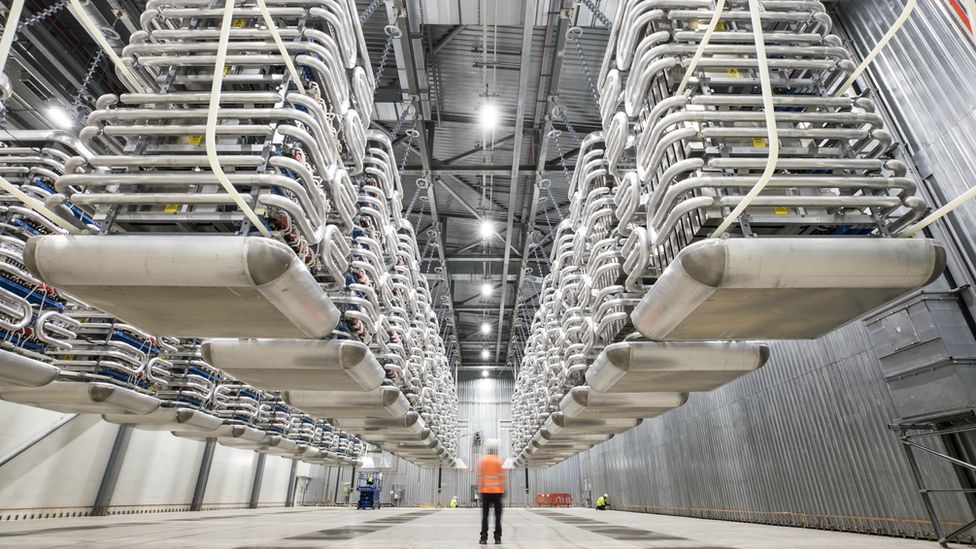
Funny-looking stuff, isn't it? Being for very high voltages does that to designs.
| Re: Aberthaw Power Station and Decarbonisation Posted by broadgage at 15:58, 22nd January 2021 | |
These interconnectors are IMHO a good thing. They provide valuable flexibility to obtain the cheapest electricity under normal conditions, and to provide electricity at almost any price in an emergency such as a breakdown of generating plant.
My only concerns are that TPTB regard more interconnectors as being a subsititute for building enough UK generating capacity. I feel that we may be becoming too reliant on near continual imports, rather than also exporting power.
In my view, we should aim to export electricity on a significant basis, with exports being broadly similar to imports. At present we are largely importing power with only limited exports.
| Re: Aberthaw Power Station and Decarbonisation Posted by TonyK at 20:47, 22nd January 2021 | |
My only concerns are that TPTB regard more interconnectors as being a substitute for building enough UK generating capacity. I feel that we may be becoming too reliant on near continual imports, rather than also exporting power.
A couple of HVDC connectors running below the Channel or the North Sea excites much less opprobrium than any other way of generating the power. So long as we can import from our continental friends, and do so to a substantial degree, the powers that be can kick the can down the road for the next Prime Minister to pick up. Or more likely kick again. Fracking caused outrage, onshore wind projects did the same to the point that they were effectively sidelined, and nobody wants a gas power station down the road. Surprisingly, nuclear is nothing like as unpopular in its own backyard, probably because of all the well-paid jobs, but they always raise a row amongst the better informed Twitterati.
It is time, IMHO, for government to stop focusing on the generation of electricity alone, and to start talking about the nation's overall energy consumption. After all, the last new petrol-powered car will roll off the assembly line in under a decade, and new houses will not have gas boilers before then. We are likely to use roughly the same amount of energy overall, just from different places.
We import a huge amount of energy. Our own North Sea production of gas and oil peaked more than 20 years ago, and we have been net importers for quite a few years. Britain's North Sea oil amounted to 923,315 m3 in 2019. In contrast, we imported nearly 50 million m3, of which around 40% came from Norway. The story with gas seems similar.
Electricity accounts for less than a quarter of energy use here, and I struggle to figure out what is going to replace all the rest.
| Re: Aberthaw Power Station and Decarbonisation Posted by Red Squirrel at 11:19, 23rd January 2021 | |
...Electricity accounts for less than a quarter of energy use here, and I struggle to figure out what is going to replace all the rest.
I followed you until I read this last line... maybe I've misunderstood it?
Electricity will increasingly power almost everything, from transport to home heating to industry. Hydrogen, produced by electricity, will increasingly provide energy storage where high energy density is needed.
Ultimately, almost all of our energy will be electric or electrically derived. Doesn't the question therefore become: What's the right split between wind, solar, nuclear and other means of generation?
| Re: Aberthaw Power Station and Decarbonisation Posted by TonyK at 12:38, 23rd January 2021 | |
I followed you until I read this last line... maybe I've misunderstood it?
Electricity will increasingly power almost everything, from transport to home heating to industry. Hydrogen, produced by electricity, will increasingly provide energy storage where high energy density is needed.
Ultimately, almost all of our energy will be electric or electrically derived. Doesn't the question therefore become: What's the right split between wind, solar, nuclear and other means of generation?
Electricity will increasingly power almost everything, from transport to home heating to industry. Hydrogen, produced by electricity, will increasingly provide energy storage where high energy density is needed.
Ultimately, almost all of our energy will be electric or electrically derived. Doesn't the question therefore become: What's the right split between wind, solar, nuclear and other means of generation?
As always, Red Squirrel, you have explained what I was thinking, and meant, far better than I could myself. I got carried away by the smell of cake coming out of the (electric) oven, and rushed the last bit of my response.
Yes, what is going to replace the oil, gas, coal and virgin forest currently being burned to provide electricity and the energy used for all those other things, that is the querstion.
| Re: Aberthaw Power Station and Decarbonisation Posted by broadgage at 12:52, 23rd January 2021 | |
...Electricity accounts for less than a quarter of energy use here, and I struggle to figure out what is going to replace all the rest.
I followed you until I read this last line... maybe I've misunderstood it?
Electricity will increasingly power almost everything, from transport to home heating to industry. Hydrogen, produced by electricity, will increasingly provide energy storage where high energy density is needed.
Ultimately, almost all of our energy will be electric or electrically derived. Doesn't the question therefore become: What's the right split between wind, solar, nuclear and other means of generation?
Agree, there will be some alternatives but I expect that these will be a minute proprtion of the total.
Examples include direct use of wind power (sailing ships, traditional windmills to pump water)
Direct use of solar thermal energy, to heat swimming pools, dry crops, produce salt, and the like.
Burning of wood for domestic heating, fine for older properties with a significant heating demand. Trees are an important part of the landscape and do not live forever. Harvest and burn some of the old ones. Trees are required for construction timber, burn all the reject bits. Burn the scrap timber when a building is knocked down.
These non electric energy sources will be a very small proprtion of the total, and I mention them only in the interests of accuracy and completness.
The future is electric for most energy needs, and this electricity should be produced renewably.
There will regretably be a need for some coal, not for heating or electric power production, but for iron and steel manufacture. Coke produced from coal, is unavoidable for iron production since it is not just a heat source but a source of carbon whereby iron oxide is reduced to iron.
For this reason I reluctantly support the proposed new coal mine.
Iron and steel are vital for a modern economy, or even a Victorian economy.
EDIT TO ADD LINK re new coal mine
https://www.bbc.co.uk/news/science-environment-55766306
| Re: Aberthaw Power Station and Decarbonisation Posted by TonyK at 14:38, 23rd January 2021 | |
There will regretably be a need for some coal, not for heating or electric power production, but for iron and steel manufacture. Coke produced from coal, is unavoidable for iron production since it is not just a heat source but a source of carbon whereby iron oxide is reduced to iron.
For this reason I reluctantly support the proposed new coal mine.
Iron and steel are vital for a modern economy, or even a Victorian economy.
I agree, except for the reluctance. There are ways to make steel without coke, at least in the laboratory, with hydrogen being the most likely to be scaled up to blast furnace scale. Recycling of steel is already done with arc furnaces, meaning that half the technology is already available. Until then, coke it is. The alternatives to the new coal mine are, for the time being at least, either buy the coal from overseas, adding the transport emissions to all the rest, or buying the steel from overseas. That would be politically unacceptable, and a strategic mistake, so the government will put up with the noise from the anti-mine protests.
I don't buy into the idea of hydrogen for cars and home heating. It makes more sense to me to use electricity, as the distribution network is already in place. I see a lot of stuff on the web promoting it as the way forward, which I see as just getting the cheerleaders ready to warm the government up for a nice round of subsidies.
| Re: Aberthaw Power Station and Decarbonisation Posted by Red Squirrel at 15:02, 23rd January 2021 | |
...Until then, coke it is.
Indeed: https://www.youtube.com/watch?v=ACzbCi3oN1M
You may note that this video was posted by 'Root Canal Pro'. And you may stop watching after the first one (or earlier).
| Re: Aberthaw Power Station and Decarbonisation Posted by Oxonhutch at 15:10, 23rd January 2021 | |
I read that article and saw references to fossil fuels but not one mention that this is not what the coking coal is for - as a chemical ingredient in the iron-carbon alloy we call steel. I found the content a bit disingenuous to be honest.
| Re: Aberthaw Power Station and Decarbonisation Posted by Hal at 15:55, 23rd January 2021 | |
Many steel companies around the world are researching ways to replace coke with hydrogen. One of the most advanced projects is in Sweden where a consortium called ?Hybrit? began constructing a pilot plant in 2018. But they don?t expect to have a workable solution till 2035. And initial studies indicated the production cost would be 20-30% higher than using coke to make steel.
An alternative process already exists ? direct reduction of iron ore using reformed natural gas. This is less carbon-intensive than the coke-based process, but of course not fossil-free.
| Re: Aberthaw Power Station and Decarbonisation Posted by TonyK at 19:40, 23rd January 2021 | |
Many steel companies around the world are researching ways to replace coke with hydrogen. One of the most advanced projects is in Sweden where a consortium called ?Hybrit? began constructing a pilot plant in 2018. But they don?t expect to have a workable solution till 2035. And initial studies indicated the production cost would be 20-30% higher than using coke to make steel.
An alternative process already exists ? direct reduction of iron ore using reformed natural gas. This is less carbon-intensive than the coke-based process, but of course not fossil-free.
It seems building a blast furnace that will work safely with hydrogen at 1300C in the presence of oxygen enriched air is not as easy as it sounds.
| Re: Aberthaw Power Station and Decarbonisation Posted by broadgage at 22:20, 23rd January 2021 | |
Many steel companies around the world are researching ways to replace coke with hydrogen. One of the most advanced projects is in Sweden where a consortium called ?Hybrit? began constructing a pilot plant in 2018. But they don?t expect to have a workable solution till 2035. And initial studies indicated the production cost would be 20-30% higher than using coke to make steel.
An alternative process already exists ? direct reduction of iron ore using reformed natural gas. This is less carbon-intensive than the coke-based process, but of course not fossil-free.
It seems building a blast furnace that will work safely with hydrogen at 1300C in the presence of oxygen enriched air is not as easy as it sounds.
Indeed, It might well be achieved eventually but sounds dangerous. It expect that a mixture of oxygen and hydrogen, injected via separated pipes will be needed. Hydrogen in excess if compared to the mixture needed for perfect combustion. Most of the hydrogen and oxygen would burn fiercely and produce the great heat needed.
The excess hydrogen would react with iron ore and reduce it to metallic iron. Iron oxide + hydrogen=iron + water.
To produce steel, carbon from coke or an equivalent would still be needed, but in much smaller volumes than used at present.
| Re: Aberthaw Power Station and Decarbonisation Posted by TonyK at 01:00, 24th January 2021 | |
The excess hydrogen would react with iron ore and reduce it to metallic iron. Iron oxide + hydrogen=iron + water.
Funnily enough, I did that one in school, in the very last days of town gas, when you were allowed to blow things up in the name of education. I had a small amount of basically rust in a charcoal crucible, and using a thing glass tube, I blew burning gas from the Bunsen burner over this, producing actual metal! Plus, I assume, water vapour that vanished before my eyes. The teacher explained that we were being switched to the new North Sea gas soon, which didn't have hydrogen in free form, so he would have to use a cylinder of hydrogen next year.
Then, bored with my mastery of alchemy, I amused myself by attaching a rubber hose to the gas tap, turning it on and blowing hard down the tube, debating with a co-conspirator which way the gas flowed, and whose Bunsen would go out next.
| Re: Aberthaw Power Station and Decarbonisation Posted by Oxonhutch at 08:56, 24th January 2021 | |
The carbon monoxide content of town gas would have helped the reduction reaction as well to but I can understand Sir not wanting to use a cylinder of that the following year.
| Re: Aberthaw Power Station and Decarbonisation Posted by TonyK at 13:00, 24th January 2021 | |
The carbon monoxide content of town gas would have helped the reduction reaction as well to but I can understand Sir not wanting to use a cylinder of that the following year.
Me too! hydrogen is fun in small quantities - I can't be the only one to have soap bubbles filled with hydrogen explode in the palm of my hand. ("Implode - get it right, laddie!"). It gets a lot more serious at volumes above half a litre.
| Re: Aberthaw Power Station and Decarbonisation Posted by Oxonhutch at 19:59, 24th January 2021 | |
Mid 70's, now with natural gas - methane. We had all read about a poor soul that wanted to end it all with their head in the converted oven and predictably failed - methane being non-toxic. A reflective cigarette, however changed the order of things and the explosion was final.
We did a similar experiment post town gas in my class (age 14/15?). Baby powder tin with hole in bottom suitable for rubber gas pipe. Nail hole in lid, firmly pressed on to tin. Start gas supply and light lazy flame flame coming out of the top of tin. So benign... ...
Turn off gas and wait for methane air mix to reach critical proportion - and loud bang with kids - including me - trying to dodge ricocheting lid. Great lesson - great learning - would never now pass HSE.
Post Uni, I gave a talk to the kids at my old school, and the savage tear in the ceiling tile was still there.. Inspired the scientist in me it did - and gave me a healthy respect for nature ...
... until I thought a 44 gallon drum full of rubbish, 30 C African sun, a cup of petrol, and a match was a solution to a problem. That, taught me nature

| Re: Aberthaw Power Station and Decarbonisation Posted by TonyK at 09:27, 25th January 2021 | |
... until I thought a 44 gallon drum full of rubbish, 30 C African sun, a cup of petrol, and a match was a solution to a problem. That, taught me nature
A potentially very painful lesson!
| Re: Aberthaw Power Station and Decarbonisation Posted by broadgage at 04:20, 26th January 2021 | |
... until I thought a 44 gallon drum full of rubbish, 30 C African sun, a cup of petrol, and a match was a solution to a problem. That, taught me nature
A potentially very painful lesson!
Did you hear about poor old Fred ?
No, what happened to old Fred ?
He struck a match to inspect the level in his petrol tank.
You would think that would be the last thing he would do !
It was.
| Re: Aberthaw Power Station and Decarbonisation Posted by stuving at 23:19, 28th January 2021 | |
Two reports just out say that last year, for the first time, renewables provided more energy that fossil fuels in the UK and the EU (now 27). The UK one is from Ember (a think tank that was called Sandbag until last October), the EU one Ember with Agora Energiewende.
I'm not sure how Covid affected overall demand for the whole year, and even after looking at the data file they make available I'm still not sure. For one thing the data table does include the UK, though the report doesn't. Presumably if demand dropped, and wind (in particular) had enough priority to displace gas and coal, that alone would push the renewables percentage up. On the other hand, nuclear (which counts as neither) fell quite a bit (due mainly to closures in France, some temporary some not) which would have the opposite effect.
| Re: Aberthaw Power Station and Decarbonisation Posted by TonyK at 00:36, 29th January 2021 | |
Two reports just out say that last year, for the first time, renewables provided more energy that fossil fuels in the UK and the EU (now 27). The UK one is from Ember (a think tank that was called Sandbag until last October), the EU one Ember with Agora Energiewende.
I'm not sure how Covid affected overall demand for the whole year, and even after looking at the data file they make available I'm still not sure. For one thing the data table does include the UK, though the report doesn't. Presumably if demand dropped, and wind (in particular) had enough priority to displace gas and coal, that alone would push the renewables percentage up. On the other hand, nuclear (which counts as neither) fell quite a bit (due mainly to closures in France, some temporary some not) which would have the opposite effect.
I'm not sure how Covid affected overall demand for the whole year, and even after looking at the data file they make available I'm still not sure. For one thing the data table does include the UK, though the report doesn't. Presumably if demand dropped, and wind (in particular) had enough priority to displace gas and coal, that alone would push the renewables percentage up. On the other hand, nuclear (which counts as neither) fell quite a bit (due mainly to closures in France, some temporary some not) which would have the opposite effect.
Renewables provided more electricity than fossil fuels, but certainly not more energy. Don't forget all the heating, hot water, motive power etc provided by gas, oil and coal, accounting for some 75% of energy consumption in this country. The figures for renewable energy also include biomass, which in turn includes Drax power station's burning of 8 million tonnes of wood annually, much of it sourced by clearing forests in Europe and North America. That constitutes a scandal in my book, not renewable energy.
Nuclear is not renewable energy, because there is a finite supply of the fuel, and they ain't making no more*. That said, there is plenty around, and better ways of using it and disposing of the waste are coming along. The original purpose of atomic piles was to produce plutonium for bombs, with electricity a by-product to get rid of the vast heat generated. We have enough of that however you care to measure it, and could use it and the existing waste for fuel. Fusion power is only 10 years away, as it has been since I was a kid.
Stories like this come out regularly. While the reduction in fossil fuel use is to be welcomed, the spin is not particularly helpful. A better measure would be of how much of our total energy use is renewable, and that might concentrate minds a bit more than a few good news stories designed to urge governments to pay for more wind turbines, and promises of vast arrays of batteries and hydrogen plants to use up all the excess renewable energy that doesn't exist.
The pandemic certainly did suppress our electricity use, with so many places closed and travel reduced. The scorchio weather in summer helped too, although if temperatures like that become standard, we Brits will follow our cousins in warmer climes, and install aircon at home. Electricity consumption was otherwise falling for other reasons - we are getting more efficient at using it. If I switched on every light in my house, they wouldn't use as much power as the two 4 x 50W GU10 reflector units in my kitchen at the previous house. The 43" smart TV uses a lot less power than did the family's first Baird 14" black and white telly. The induction hob, microwave oven and fan oven use an awful lot less than the electric hobs still found in many homes. The cuckoo in the nest seems to be the ever-growing demand from data services, with the maintenance of Bitcoin alone using more electricity than many countries - about the same as Panama, or double that of Cyprus. (I'm not making this up - read Bitcoin's own news site). That will change abruptly when the bubble bursts.
You have spotted the truth about the effect of renewables on forms of generation - when the sun shines and the wind blows, we can turn the gas down a bit. Not a lot of people seem to grasp that particular point - there is never a moment in time when electricity in this country is not being generated by fossil fuels. Stories about spending a week without burning coal or renewables outstripping fossil fuels tend to obscure that very inconvenient truth. So we still have to replace about 60% of our electricity generating capacity, a lot more if we follow Germany down the "no more nukes" path, to get to carbon neutral without the use of accounting trickery. Then we have to provide for all the cars, buses, trains, central heating, industry, etc etc to run on electricity.
(* Alright, I know, physiciists are busy doing this as we speak, and nuclear power stations do it fleetingly all the time, but it's not on general sale.)
| Re: Aberthaw Power Station and Decarbonisation Posted by broadgage at 01:08, 29th January 2021 | |
Agree, the UK has made good progress WRT to renewably generated electricity, but transport and fuel burning heating has been rather neglected.
It would be rather optimistic to expect a journalist or a politician to know the difference between electricity and total energy.
The other "fly in the ointment" is the fact that generating half our electricity from renewables is relatively easy, but renewably generating ALL our electricity is a much greater challenge. Politicians tend to assume that we are "half way there" and that achieving the second half will be as easy.
Likewise with energy saving, some savings are easy, but we have largely already done the easy bits. Future savings will be more challenging.
| Re: Aberthaw Power Station and Decarbonisation Posted by Bmblbzzz at 10:12, 29th January 2021 | |
The point about energy use, as opposed to generation, is well made.
| Re: Aberthaw Power Station and Decarbonisation Posted by stuving at 10:40, 29th January 2021 | |
It would be rather optimistic to expect a journalist or a politician to know the difference between electricity and total energy.
Maybe, but I should have spotted the sneakily-worded titles of those reports and not just copied them.
But I hope that was said with an edge of sarcasm - and it was a factor in the 2007 French presidential election. There was just one TV debate, between the two rounds of voting, between Sarkozy and Ségolène Royal. She'd surprised many people by her successful "glamour" makeover, and was also trying to show she could be forceful. Sarkozy had already shown a quick temper, but in the debate adopted the - rather bizarre - persona of a polite schoolboy. Maybe that was a technique to stay calm, in which case it worked; she didn't.
That was the one thing most reports mention now, but what struck me at the time was an exchange on the amount of French electricity coming from nuclear. He said it was half, she corrected him with 17%, and he insisted (politely) he was right while she dug in her heels ... four times! Then they moved on, but it was picked up in the next day's analyses. The true figure was 78% (17% was for all energy use), so by some reports Sarkozy was wrong too - but I understood "half" as much less exact than "50%", and implying "at least" too.
| Re: Aberthaw Power Station and Decarbonisation Posted by TonyK at 11:26, 29th January 2021 | |
There are lies, damned lies, and statistics. The French version of Gridwatch is interesting when compared to the UK figures. 70% of French electricity comes from nuclear as we speak, but they have a lot more wind energy today than we have, too. French demand for electricity is huge compared to ours, at 67GW vs our own 25.6GW, but with a slightly smaller population. I'm not sure what they do with it all, especially if 70% of electricity by nuclear equates to just 17% of energy. That suggests broadly the same proportion of energy consumed via generated electricity as in the UK. We are using 1.5GW of it via the interconnector, which is why I refer to our offshore nuclear facility, and the railway is a lot more electric than ours, but I struggle to understand fully.
Seems that Ségolène Royal had understood the difference between electricity and energy better than M Sarkozi, but didn't know that she understood it.
| Re: Aberthaw Power Station and Decarbonisation Posted by Red Squirrel at 11:41, 29th January 2021 | |
French demand for electricity is huge compared to ours, at 67GW vs our own 25.6GW...
Right now, the UK is consuming 38GW and France is consuming 67GW - so not quite as different as your snapshot. And 2GW of our consumption is being generated in, er, France. Makes you wonder though: are they a bit more profligate they have so much nuclear power to play with?
| Re: Aberthaw Power Station and Decarbonisation Posted by stuving at 11:56, 29th January 2021 | |
There are lies, damned lies, and statistics. The French version of Gridwatch is interesting when compared to the UK figures. 70% of French electricity comes from nuclear as we speak, but they have a lot more wind energy today than we have, too. French demand for electricity is huge compared to ours, at 67GW vs our own 25.6GW, but with a slightly smaller population. I'm not sure what they do with it all, especially if 70% of electricity by nuclear equates to just 17% of energy. That suggests broadly the same proportion of energy consumed via generated electricity as in the UK. We are using 1.5GW of it via the interconnector, which is why I refer to our offshore nuclear facility, and the railway is a lot more electric than ours, but I struggle to understand fully.
Seems that Ségolène Royal had understood the difference between electricity and energy better than M Sarkozi, but didn't know that she understood it.
Seems that Ségolène Royal had understood the difference between electricity and energy better than M Sarkozi, but didn't know that she understood it.
That would depend on the context, and particularly what led up to that exchange, which I can't remember now. But with hindsight gained from her subsequent pronouncements, you wouldn't expect too much correctitude.
Having all that "cheap" electricity from the 70s did lead to a lot of French housing being ell-electric, with a government push behind it. It was gas that was squeezed out, seeing nothing like the big growth that happened here (replacing coal) once North Sea gas landed. As a result, gas didn't reach as far out of town as here, and oil heating is much bigger as a result. (As an aside, I remember in the 70s playing darts with a boiler fitter, who was so busy replacing oil boilers with gas ones in quite rural places he'd stopped doing anything else.) Recent plans to ban new oil boilers soon, and replacement ones maybe not long after, have led to much screaming and shouting from a non-metropolitan demographic similar to the gilets jaunes.
| Re: Aberthaw Power Station and Decarbonisation Posted by TonyK at 15:27, 29th January 2021 | |
Right now, the UK is consuming 38GW and France is consuming 67GW - so not quite as different as your snapshot. And 2GW of our consumption is being generated in, er, France. Makes you wonder though: are they a bit more profligate they have so much nuclear power to play with?
That's odd. I took my numbers from a version of Gridwatch recommended to me by a certain squirrel:

rather than the one I was then accustomed to:

which I thought were merely different representations of the same source data. I thought our consumption figure seemed a little light, and shall revert.
Having all that "cheap" electricity from the 70s did lead to a lot of French housing being ell-electric, with a government push behind it. It was gas that was squeezed out, seeing nothing like the big growth that happened here (replacing coal) once North Sea gas landed. As a result, gas didn't reach as far out of town as here, and oil heating is much bigger as a result. (As an aside, I remember in the 70s playing darts with a boiler fitter, who was so busy replacing oil boilers with gas ones in quite rural places he'd stopped doing anything else.) Recent plans to ban new oil boilers soon, and replacement ones maybe not long after, have led to much screaming and shouting from a non-metropolitan demographic similar to the gilets jaunes.
Living in that non-metropolitan bit, I wonder how much of the shouting of spite comes from the consumers, and how much from the fuel merchants who see their cosy cartel at risk. There are often gripes about oil prices and availability, and quite a few people I know have given up oil for bottled gas. Our village is blessed with mains gas, but my other village, which is bigger, is not. For years, there was a quiet campaign to get the gas network extended from only a couple of miles away, but it was accepted glumly a few years back that it will never happen. We are all electric there, with an open fire. Wood, coal, and bottled gas are the most popular add-on fuel, with a few still stuck with oil. They are not as noisy as les gilets jaunes, writing stiff letters to the newspaper while the other chaps blockade motorways and burn effigies.
The French relationship with government is different to ours in my limited experience, something de Gaulle put down to the cheese. That could be part of the answer. Electricity had a bureaucracy all of its own at the time, and I am guessing that would have been the same for any mains gas supplies too.
I worked in a few places out in the sticks in France long ago, and never saw mains gas. France does not have the great reserves of gas that we enjoyed until recently, and I have no idea how it worked in the cities. Hot water, even then, was often solar powered in the south, with logs providing the heat in the autumn on the farm where I first worked, as well as fuel to roast rabbits and fowl. Happy days.
