








| Changes to Stranraer Posted by grahame at 05:10, 25th January 2015 |     |
An interesting proposal for a bi-mode train (but not a high speed one like the IEP) to run to Stranraer -
http://www.carricktoday.co.uk/news/local-headlines/last-ditch-plea-to-save-direct-glasgow-train-links-1-3667988
Last-ditch plea to save direct Glasgow train links
A crisis meeting is being sought in an 11th-hour effort to stop the effective ending of direct rail links with Glasgow after 138 years.
Elected members from Wigtownshire, South Ayrshire and SAYLSA, the line^s community rail partnership, are to ask for a meeting with the Scottish Government^s Transport Minister after plans by the Dutch firm to end direct links with Glasgow.
Since Abellio took over the Scotrail franchise last autumn, the three direct trains from Stranraer to Glasgow have come under threat.
Elected members also have ^discriminatory^ concerns about Glasgow-bound disabled passengers having to go via North Ayrshire to change trains for the city if the direct service is axed. By December 2017 Abellio wants to cut the three direct trains to the city, retaining only one late evening train going north and one going south.
[snip]
^However, I also recognise the concerns regarding the loss of two of the three direct services.^ Dr Mhairi McKenna, chair of SAYLSA, said: ^We have been lobbying for the retention of some through services at sensible times for some time now and we would like to thank Dumfries and Galloway councillors for listening to our requests. Both locals and visitors need a good level of direct trains and we are hopeful common sense will prevail.^
In the longer term the Partnership is seeking the commitment of the Scottish Government towards bi-mode (dual electric/diesel power) hybrid trains.
SAYLSA development manager Richard Carr said: ^France has had these trains for 10 years and for Stranraer they would be our preferred choice.^
A crisis meeting is being sought in an 11th-hour effort to stop the effective ending of direct rail links with Glasgow after 138 years.
Elected members from Wigtownshire, South Ayrshire and SAYLSA, the line^s community rail partnership, are to ask for a meeting with the Scottish Government^s Transport Minister after plans by the Dutch firm to end direct links with Glasgow.
Since Abellio took over the Scotrail franchise last autumn, the three direct trains from Stranraer to Glasgow have come under threat.
Elected members also have ^discriminatory^ concerns about Glasgow-bound disabled passengers having to go via North Ayrshire to change trains for the city if the direct service is axed. By December 2017 Abellio wants to cut the three direct trains to the city, retaining only one late evening train going north and one going south.
[snip]
^However, I also recognise the concerns regarding the loss of two of the three direct services.^ Dr Mhairi McKenna, chair of SAYLSA, said: ^We have been lobbying for the retention of some through services at sensible times for some time now and we would like to thank Dumfries and Galloway councillors for listening to our requests. Both locals and visitors need a good level of direct trains and we are hopeful common sense will prevail.^
In the longer term the Partnership is seeking the commitment of the Scottish Government towards bi-mode (dual electric/diesel power) hybrid trains.
SAYLSA development manager Richard Carr said: ^France has had these trains for 10 years and for Stranraer they would be our preferred choice.^
The train pictured in the article looks like this one:
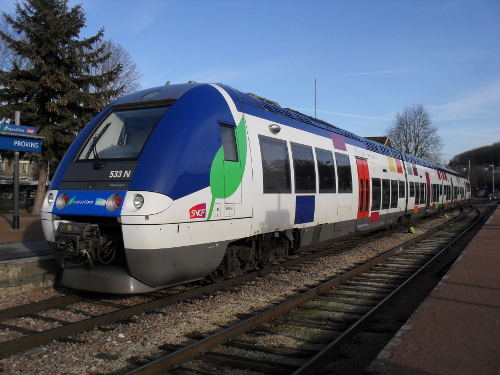
Taken by Eole99 , B 82500 Transilien ^ Provins , 26th December 2009, reproduced here under creative commons license (wikipedia) - see http://commons.wikimedia.org/wiki/File:B82500_Provins5.JPG
And I can't help wondering if it's a bit wide and tall for the loading gauge? We've been talking IPEMU (battery electric) recently - is there a good case for electric / diesel hybrids for more local use? How expensive would they be if indeed this French design (or another) has been identified as fitting the loading gauge?
| Re: Changes to Stranraer Posted by stuving at 10:45, 25th January 2015 | |
The train pictured in the article looks like this one:
Taken by Eole99 , B 82500 Transilien ^ Provins , 26th December 2009, reproduced here under creative commons license (wikipedia) - see http://commons.wikimedia.org/wiki/File:B82500_Provins5.JPG
And I can't help wondering if it's a bit wide and tall for the loading gauge? We've been talking IPEMU (battery electric) recently - is there a good case for electric / diesel hybrids for more local use? How expensive would they be if indeed this French design (or another) has been identified as fitting the loading gauge?
Taken by Eole99 , B 82500 Transilien ^ Provins , 26th December 2009, reproduced here under creative commons license (wikipedia) - see http://commons.wikimedia.org/wiki/File:B82500_Provins5.JPG
And I can't help wondering if it's a bit wide and tall for the loading gauge? We've been talking IPEMU (battery electric) recently - is there a good case for electric / diesel hybrids for more local use? How expensive would they be if indeed this French design (or another) has been identified as fitting the loading gauge?
Beware of sub-editors bearing pictures lifted off the web and captions written without reading the article. The suggestion as reported is just to look at bimode trains in general - not a design that would indeed never run on that line. It's possibly too long as well - all the french ones are 4-car minimum. These days the makers can take one of their designs and all the on-board systems and make trains for Britain out of them. Subject, of course, to the space available for the big bits, and that is likely to be important for diesel engines.
But the question, really, is why do you need one rather than just running diesels? Possible reasons:
- Performance on main lines, which are electrified, and lower speeds on branch/regional lines. (This applies to IEP.)
- Regulations - a diktat says "no diesels from now in in our big shiny main-line stations".
- Fuel saving - a genuine need to limit diesel burn to the minimum.
- Emission control (again could be genuine or a more arbitrary regulation.)
- Most reasons count for more if the off-wire distance is relatively short. (This also favours wiring it, of course.)
- Most reasons also count for more for higher service levels.
I'm not sure why the French like them, but the fact that they came out of a programme for high-capacity TER rolling stock, and current ones are all 4-6 cars, does imply they don't bother with them on lightly-used lines. I imagine that's the issue for the Stranraer line - 60 miles of track for a few little trains a day must mean someone has to come up with lots of subsidy. Unless there is freight off the ferry, which I doubt.
PS: The ferries now use Cairnryan, but as they are mentioned in the article I guess passengers are - or could be - bussed the 5 miles to Stranraer. The railway doesn't go past there, so there are no options for a station or realistically for freight.
| Re: Changes to Stranraer Posted by grahame at 13:34, 25th January 2015 | |
The ferries now use Cairnryan, but as they are mentioned in the article I guess passengers are - or could be - bussed the 5 miles to Stranraer. The railway doesn't go past there, so there are no options for a station or realistically for freight.
In the past, Cairnryan was rail served (from Wikpedia):
During World War II, Cairnryan became No.2 Military Port, and three harbour piers and a military railway, linking the village with nearby Stranraer, were built by the army. For a period after the war, continuing at least until 1958, the port was used to receive, by rail and Liberty/Victory ships, surplus/time-expired ammunition which was loaded onto army landing craft for disposal at sea. That coming by rail, had trucks labelled with the address, "Davy Jones' Locker, Cairnryan".
But now the transfer is from Ayr by bus / which according to some reports has become a minibus.
You're spot on with your comments about the dangers of stock photography, and the apparent issues with running bimode trains to Stranraer. The line, with the ferry connection gone, becomes one of the more difficult cases around to run cost effectively (that's written with little local understanding of the area - I stand to be corrected) and the station use figures for Stranraer show either some really good marketing to keep the numbers up when the ferry left, or ferry service that in practise took very few people arriving there by train even when it left from the Harbour station.
Annual journeys:
Stranraer around 45,000
Barrhill around 5,000
Girvan around 140,000 (some trains turn back there)
Maybole around 70,000
And so to Ayr. Adding the above, making a small allowance for local traffic, you've got around 500,000 journeys a year on about 26 trains a day - something like 50 passengers per train, which ain't bad. Taking the section south from Girvan, 12 trains per day, you've got figures of around 23 passengers per train. So three quarters of the passengers use the northern third of the line (measured in journey time) and only a quarter use the southern two thirds.
| Re: Changes to Stranraer Posted by eightf48544 at 13:41, 25th January 2015 | |
Classic Pareto principle.
| Re: Changes to Stranraer Posted by grahame at 04:58, 27th July 2016 | |
From Daiiy Record an Sunday Mail
A Dumfries man is demanding the re-opening of a Dumfries-Stranraer railway line.
Sandy Rogerson wants to see the 73-mile route brought back to life to improve trade links, boost tourism and reduce lorry traffic on the A75.
An online petition launched last week , gathered more than 500 signatures in three days and now has more than 800.
Sandy said: "It would increase public transport options, put Galloway back on the railway map, remove lorry traffic from the A75 and increase tourism in the region.
"The bus service is abysmal. It takes two and a half hours to travel to Stranraer, there are huge gaps between journeys and they don’t match up with the ferries or trains.
"The line should never have been closed."
The Paddy Line has been shut since the 1960s, when the Beeching axe fell on more than 2,000 rural lines.
Sandy, who works as a carer in Dumfries, plans to organise a public meeting in Castle Douglas to gather support for his campaign.
The 46-year-old added: "This would be a costly project and if you were just to think about that then it would be chucked right out of the window.
"But surely if the government considers the potential for tourists and transfer links, then it’s a different story.
"People said re-opening the Borders line was fantasy and look what happened there. Is it not time for Dumfries and Galloway to do the same?"
Sandy Rogerson wants to see the 73-mile route brought back to life to improve trade links, boost tourism and reduce lorry traffic on the A75.
An online petition launched last week , gathered more than 500 signatures in three days and now has more than 800.
Sandy said: "It would increase public transport options, put Galloway back on the railway map, remove lorry traffic from the A75 and increase tourism in the region.
"The bus service is abysmal. It takes two and a half hours to travel to Stranraer, there are huge gaps between journeys and they don’t match up with the ferries or trains.
"The line should never have been closed."
The Paddy Line has been shut since the 1960s, when the Beeching axe fell on more than 2,000 rural lines.
Sandy, who works as a carer in Dumfries, plans to organise a public meeting in Castle Douglas to gather support for his campaign.
The 46-year-old added: "This would be a costly project and if you were just to think about that then it would be chucked right out of the window.
"But surely if the government considers the potential for tourists and transfer links, then it’s a different story.
"People said re-opening the Borders line was fantasy and look what happened there. Is it not time for Dumfries and Galloway to do the same?"
The petition can be found at: you.38degrees.org.uk/petitions/reopen-the-dumfries-stranraer-railway .
| Re: Changes to Stranraer Posted by caliwag at 13:20, 28th July 2016 | |
Erm...While we are on a Scottish theme, this from Peterhead...well an update...don't hold your breath
http://www.scottishconstructionnow.com/13770/councillors-defer-peterhead-expansion-decision-as-rail-plan-revealed/?
| Re: Changes to Stranraer Posted by Chris from Nailsea at 00:15, 4th February 2026 | |
I'm going to resurrect an old topic here, with an update from the BBC:
Plan to move Stranraer rail station away from old ferry terminal
[Image from here is not available to guests]
The new station would be brought closer to the town centre
Provisional plans have been unveiled for the potential development of a new railway station in Stranraer.
Network Rail wants to relocate the existing platform away from a former terminal on the East Pier which saw the last ferry leave nearly 15 years ago.
Architects have produced options for two sites - both of them closer to the town centre and linked to a new mobility hub. The project - which it is hoped could be delivered for under £5m - would be based on a new modular design concept to deliver a modern and visually-attractive building, and support local regeneration.
[Image from here is not available to guests]
The community has campaigned to move the station after the ferry terminal it served closed in 2011
The current station is located on a pier at Stranraer harbour. In 2011, the ferry terminal was relocated along the coast at Cairnryan leaving the facility "feeling remote from the town centre".
Since then, the community has campaigned to relocate the station closer to the heart of Stranraer - currently about 15 minutes' walk away. Among the key considerations for its replacement have been better connection to the town centre, an improved passenger experience and capacity to accommodate charter trains. The details of the plan are included in a Network Rail feasibility study.
Matthew Powell, the firm's head of sponsorship, outlined the proposals to the region's transport partnership, Swestrans. He said they were "keen to move quite quickly" with the latest plans.
Powell added that, having spoken to charter train operators, the distance from the station to the town was a major concern whereas a facility nearer the centre could "bring value" to the area. He added that they hoped it could be more than just a functional station.
(BBC article continues)
[Image from here is not available to guests]
The new station would be brought closer to the town centre
Provisional plans have been unveiled for the potential development of a new railway station in Stranraer.
Network Rail wants to relocate the existing platform away from a former terminal on the East Pier which saw the last ferry leave nearly 15 years ago.
Architects have produced options for two sites - both of them closer to the town centre and linked to a new mobility hub. The project - which it is hoped could be delivered for under £5m - would be based on a new modular design concept to deliver a modern and visually-attractive building, and support local regeneration.
[Image from here is not available to guests]
The community has campaigned to move the station after the ferry terminal it served closed in 2011
The current station is located on a pier at Stranraer harbour. In 2011, the ferry terminal was relocated along the coast at Cairnryan leaving the facility "feeling remote from the town centre".
Since then, the community has campaigned to relocate the station closer to the heart of Stranraer - currently about 15 minutes' walk away. Among the key considerations for its replacement have been better connection to the town centre, an improved passenger experience and capacity to accommodate charter trains. The details of the plan are included in a Network Rail feasibility study.
Matthew Powell, the firm's head of sponsorship, outlined the proposals to the region's transport partnership, Swestrans. He said they were "keen to move quite quickly" with the latest plans.
Powell added that, having spoken to charter train operators, the distance from the station to the town was a major concern whereas a facility nearer the centre could "bring value" to the area. He added that they hoped it could be more than just a functional station.
(BBC article continues)
